You've heard the words "Designer Days" mentioned - perhaps in a newsletter, in a conversation with your account manager, or by a colleague who came home from them and was unusually satisfied.
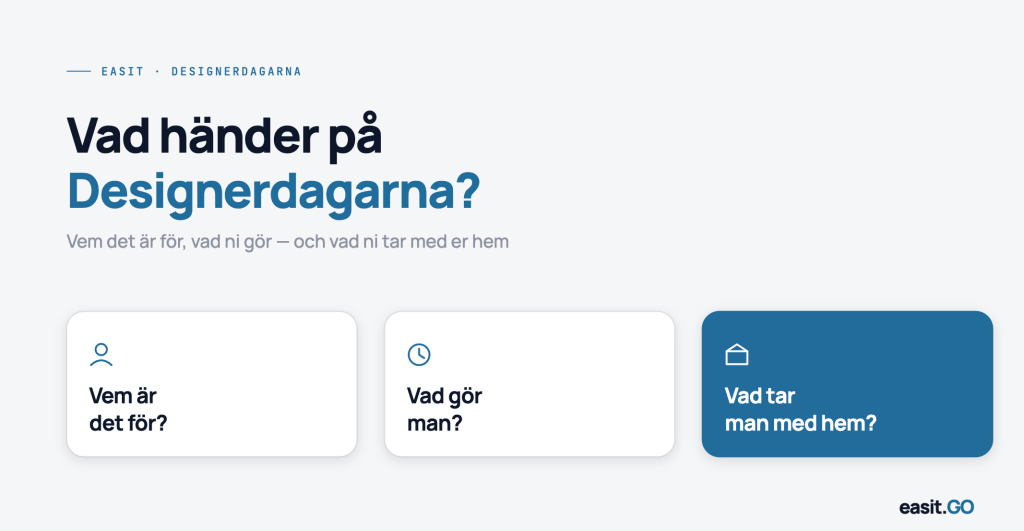
But what actually happens during the Designer Days? Who is it for, what do you do and what do you take home?
This article answers those questions.
Background. Why Designer Days exist
Easit GO is a system that is built to be owned and developed by the organization that uses it. This means that the system designer – the person who configures forms, automations, views and processes – plays a key role in how well the system actually delivers value over time.
Training provides the theory. Documentation provides the answers to specific questions. But the kind of knowledge that makes a system designer really good, the feel for how to think about configuration, how to solve a problem elegantly, how to avoid the common pitfalls, is easier to acquire together.
Designer Days were created to fill that gap.
Who are the Designer Days for?
The Designer Days are for those of you who configure and further develop Easit GO in your organization, regardless of how long you have been doing it.
It doesn't matter if you are new to the role and want to get started faster, or if you have been working with the system for a long time and want to solve specific challenges, exchange experiences with colleagues in other organizations, or gain new perspectives on features you haven't fully utilized.
The prerequisite is simple: that you are working with, or will soon be working with, Easit GO at the configuration level.
What happens during the days?
Designer days are hands-on. That's the most important characteristic to understand in order to set the right expectations.
You will work in Easit GO for most of the two days and listen to presentations about how others have done it. The format varies between occasions, but the Designer Days typically include:
Joint briefings
Easit facilitates walkthroughs of specific functional areas, typically ones that are relevant to many participants or have been recently updated. This could be how to build effective automation flows, how to structure CMDB relationships, or how to create self-service solutions that are actually used.
The briefings are not lectures. They are demonstrations followed by participants trying things out themselves, asking questions, and adapting to their own circumstances.
Working with common challenges
Part of the day is set aside to work on questions and challenges you brought with you to the meeting. It could be a configuration you're stuck on, an automation that's not behaving as expected, or an idea about how you want to solve a business need but don't quite know how to approach it.
Exchange of experience with other customers
Perhaps the most underestimated value of Designer Days is the opportunity to meet system designers from other organizations.
How have they solved the onboarding of new agents? Which automations have the greatest impact in their business? How do they handle situations where the business wants something that feels difficult to build?
That type of exchange of experience is difficult to replace with documentation or courses. It is collegial learning in practice.
What are you taking home with you?
The short answer: concrete knowledge you can use immediately, not just inspiration.
Because the days are about real-world problems and solutions, you'll go home with more than just a to-do list. Most participants bring home:
- Answers to specific questions. The challenges you went there with often have a solution when you leave, either because you solved them yourself, or because a consultant or colleague gave you the missing piece of the puzzle.
- New understanding of features you haven't fully used. It's common to go home with insights into possibilities in Easit GO that you didn't know existed, or that you knew about but didn't understand in their proper context.
- Contacts. Other system designers who share the same challenges and who it is natural to contact afterwards.
How do Designer Days differ from regular training courses?
Easit's training courses provide structure: a given course syllabus, defined content, a clear goal that you should be able to do X when the course is over.
Designer days are more open and the value depends on what you, and others, bring into the room.
They are also not a replacement for training, they complement it. A system designer who has taken the basic course and then participated in the Designer Days usually notices that they understand the training content in a deeper way when they translate it into practical configuration.
How often are they held and how do you register?
The Designer Days are held every two years and the next one is now in November.
More information and registration can be found here.
Would you like to know more about Designer Days or other training formats? Contact us
Read more
Training
Easit's training offering for administrators, system designers and process owners – from introductory courses to in-depth training.
How quickly can your organization be self-sufficient in Easit GO?
Guide to the roles, timelines, and learning formats that take you from implementation to internal control.
CMDB in practice: what does your organization actually need to keep track of?
Practical guide to defining and getting started with CMDB in phase 1.
Easit GO – features and capabilities
A review of the entire platform and what you can build with it.

Henrik Traveler
Commercial Product Manager
henrik.resare@easit.com
+46 70 249 36 06