
Connect everything that is connected – in one platform
What is a relationship model in Easit GO?
Structure your business exactly as it actually is
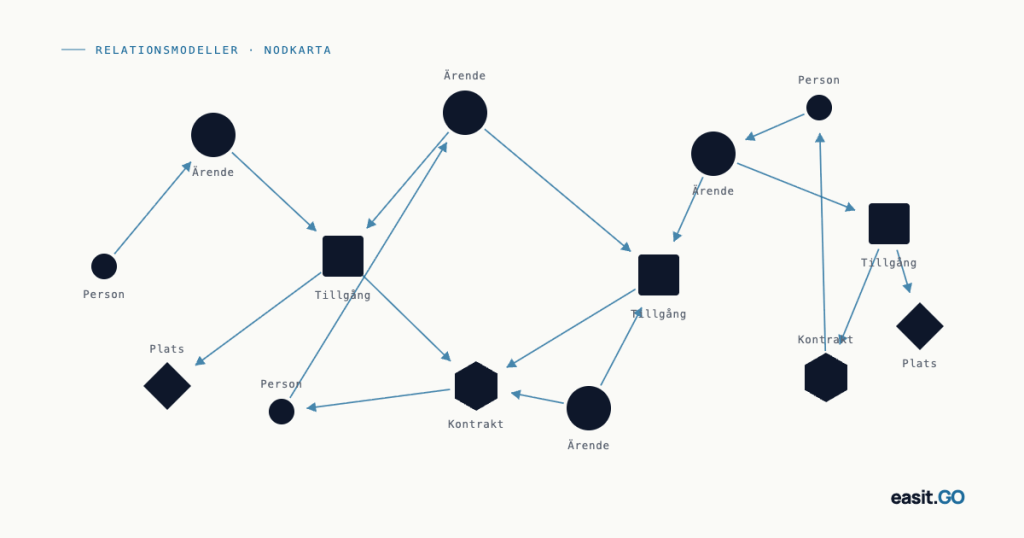
A relationship model in Easit GO describes how different types of objects relate to each other. You define which object types exist, which relationships are allowed between them, and what hierarchies should look like.
These can be simple connections – an employee belongs to a department – or complex dependency networks, such as a supplier agreement linked to specific services, responsible roles, renewal dates and associated risks.
You decide:
- What object types are available – standard objects or custom types tailored to your business
- What relationships are allowed – including direction and hierarchy
- How deep the structures can be – root level, sub-levels and rules for what can be connected to what
Everything is managed in Design Studio without programming skills. You own the model and can change it as your business changes.
Why relationship models matter
The right context changes how decisions are made
Most systems store information. Fewer systems understand the connections between information. It's the difference that determines whether you can act quickly and accurately – or whether you're forced to search, ask around, and guess.
With well-thought-out relationship models in Easit GO, every administrator, decision-maker and process owner sees exactly what is connected to what – directly in the object they are working with.
It produces concrete effects:
Faster problem resolution – follow dependency chains directly from a case without switching systems
Better impact assessment – see what is affected before a change is implemented, not afterwards
Less duplication of work – information is recorded once and reused in all processes involved
Stronger compliance – link requirements, risks and controls to the objects they actually apply to
Five areas of activity, same mechanism
A platform that understands the entire organization
The relational models in Easit GO are not built for a specific area. They are a general mechanism that you adapt to your needs. Here are five common use cases, all solved with the same underlying structure.
IT Infrastructure and Configuration Management
Build a living map of your IT environment with servers, network equipment, applications and services linked in actual dependency structures. Link CIs to incidents, changes and SLAs. Support for ITIL processes such as incident, problem and change management is built in.
Purchasing, Suppliers and Contracts
Link suppliers to contracts, contracts to services and services to internal owners and cost centers. Follow the contract lifecycle from signing to renewal. See instantly which processes and systems are affected if a supplier relationship changes.
Property and facility management
Model properties, buildings, premises and equipment in hierarchical structures. Link fault reports, maintenance issues and contracts to the right location and person responsible. Create a unified view of property information without separate tools.
GRC, GDPR and compliance
Link processing activities to the systems that carry personal data, to responsible roles, to identified risks and to implemented controls. Build a processing register and a risk register that are actually connected – in the same platform as your operational business.
Business processes and ESM
Whether it's HR processes, onboarding flows, internal service requests or cross-functional projects - the relationship models allow Easit GO to handle complex dependencies far beyond traditional IT service. A platform for service management across the entire organization.
Configurable without code, changeable without a vendor
You own your model
The relationship models are administered in Design Studio via a graphical interface. No consultants, no change orders, no waiting time.
This means that your model can grow with your business. A new department takes over an area of responsibility. A new regulatory requirement is added. A new service is launched. You update the model immediately – and all processes that use it are updated with it.
Easit GO is designed for customer autonomy. We measure our success by how little you need us after you're up and running.
Integrated throughout the platform
The relational model lives in every process
Relationships in Easit GO are not a separate configuration tool – they are active in every part of the platform:
- Case management – linked objects are displayed directly in the case card
- Rule engine – trigger rules on all or parts of the model
- Reporting – analyze data along relationship dimensions
- Design Studio – build forms that show the right relationships for the right role in the right place
Ready to build relationships that reflect your business?
Show us what your organization looks like – we'll show you how Easit GO can model it.
Book a demo or contact us and we will tell you more. Read more about Easit GO features here.
FAQ about relationship models in Easit GO
What is a relationship model in an enterprise system?
A relationship model defines how different types of objects – such as cases, assets, contracts, locations and roles – are connected to each other. It makes it possible to see dependencies, track impacts and make informed decisions, whether it's about IT operations, property management or compliance.
Are the relationship models in Easit GO limited to IT and ITSM?
No. The relationship models are a general mechanism that can be used in all parts of the business – IT, HR, purchasing, real estate, GRC and more. The same underlying structure is adapted to your needs.
Do you need programming skills to configure relational models?
No. Everything is managed in Design Studio via a graphical interface. Object types, relation types, and hierarchy rules are created and modified without code.
Can you control which relationships are allowed between different object types? Yes. You define exactly which connections are allowed, including direction and hierarchy. This keeps the data model consistent and prevents misconnections.
How are relationship models used for GRC and GDPR?
You can link processing activities to systems, responsible roles, risks and controls in a coherent flow. The processing register and risk register are directly connected to the operational business – without separate tools.
What happens if our business changes – can the model be updated?
Yes, and that is one of the strongest features. You change object types and relationships directly in Design Studio without involving Easit. The model is yours and changes at your pace.

Henrik Traveler
Commercial Product Manager
henrik.resare@easit.com
+46 70 249 36 06