You've made the decision. Easit GO is signed, the implementation project is planned and expectations are high.
But what actually happens on the day the project closes?
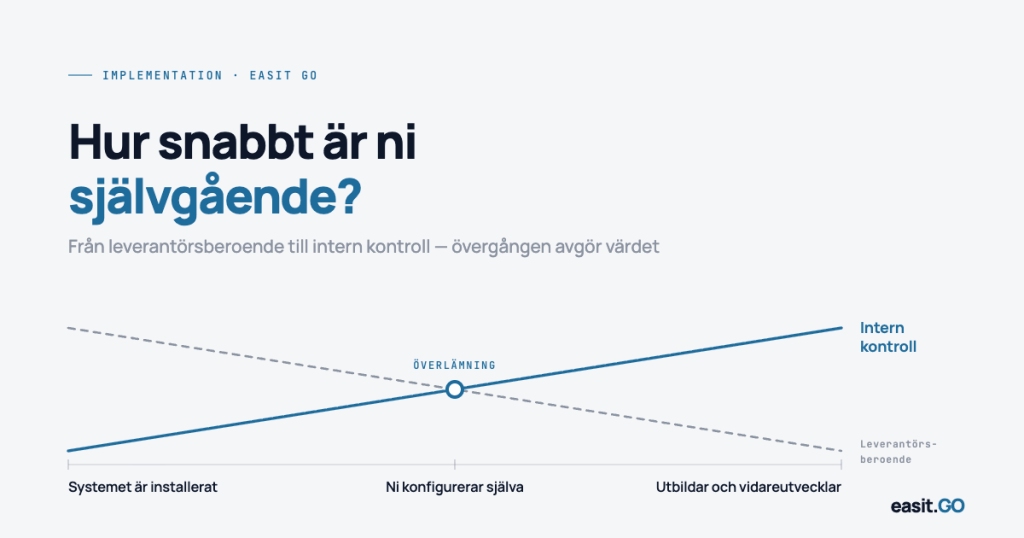
Many organizations underestimate what it takes to go from “the system is installed” to “we can configure, train, and further develop it ourselves.” That transition – from vendor dependency to internal control – is what determines whether the investment delivers value in one year, or in five.
This article is about how to get there, in practice.
Not everyone wants to take care of everything themselves and you don't have to. If you would rather have us at Easit take care of everything, or share, for you, we are happy to do that. Being independent is a choice and an opportunity. Never a compulsion.
What "autonomous" actually means
Self-driving doesn't mean you never talk to Easit again. It means you don't have to to keep the system alive and relevant.
In practice, it comes down to three things:
Adapt without a consultant. Operations change – processes are adjusted, new departments are added, forms need to be updated. A self-driven organization makes these changes internally, without opening a support case.
Train internally. When a new administrator starts or a department is to be onboarded, you can conduct the training without calling in external help.
Develop further. When you want to add a new module, automation or integration, you can take the initiative and drive the project yourself – with Easit as a sounding board, not a project manager.
The three roles you need to build competence around
Easit GO is built to be owned by the business. But the “business” needs to be concreted into people and roles.
The System Designer – Your Most Important Investment
The system designer is the person who can configure Easit GO in depth: build forms, define views, set up automations and customize processes without writing code. This is often an IT coordinator, a system administrator or a person with an interest in combining IT and business development.
This role takes the longest to build and is the most worth investing in. A competent system designer ensures that Easit GO grows with your organization instead of stagnating.
The Process Owner – the bridge between IT and business
The Process Owner understands how workflows work in practice and can translate business needs into configuration tasks. This role does not need to be deeply technical – but must understand enough about the system to have a productive conversation with the system designer.
In smaller organizations, the process owner and system designer are often the same person.
The agent – the breadth of the organization
Agents don’t need to understand how the system is built, but they need to work in it effectively. Onboarding new agents is typically the fastest training effort – but it needs to be done in a structured way and documented so that you can repeat it without each new person requiring an individual review.
Timeline: from license day to self-propelled team
Timelines vary depending on the size and ambition of the organization, but a typical pattern looks like this:
Month 1–2 Implementation and basic configuration
The system is set up, basic processes are configured, integrations are connected. Primarily Easit-led with your system designer.
Month 2–3 Parallel operation and competency learning
The system is used in live operation. The system designer learns the configuration logic and begins to take over simpler changes.
Month 3–6 Gradual transfer of ownership
You take over more and more. Administrators are trained internally. Process owners begin to formulate requirements. Easit remains as support and a sounding board – but you run the business.
Month 6+ Self-driven with a forward-looking direction
You can further develop the platform on your own initiative. New modules, automations, new departments that are onboarded. Easit provides support and new perspectives – but you own the agenda.
It can also be significantly faster, with one customer going from decision to deployment in just over two months. The journey to full autonomy takes longer, but it is a gradual transition, not a leap.
Education and continuing learning
Becoming self-reliant is not just about learning a system, it is also about building a network of expertise and colleagues who share the same challenges.
Training is available for all levels: from introduction for new administrators to advanced courses for system designers.
Designer Days bring together system designers from different organizations for practical reviews of configuration, best practices and new features in Easit GO. The format is hands-on – you leave with concrete solutions, not just inspiration.
Networking meetings are opportunities to meet other customers in a more informal way. How have others solved the onboarding of new agents? Which automations have the greatest impact? That type of exchange of experiences is difficult to replace with documentation.
The user conference brings together the entire Easit customer base and provides a comprehensive picture of the platform's direction, upcoming features, and how other organizations are using Easit GO in practice.
Mentoring is an option for organizations that want more personalized support during their journey towards self-sufficiency. An experienced Easit consultant acts as a sounding board and mentor to help you build the right skills internally.
Would you like to know more about training, designer days or the user conference? Contact us
Read more
Easit GO – features and capabilities
A review of the entire platform and what you can build with it.
CMDB in practice: what does your organization actually need to keep track of?
Practical guide to defining and getting started with CMDB in phase 1.
Customer case: Sydnärke – from decision to deployment in just over two months
How an organization went from decision to deployment quickly – and what it required.
Training
Easit's training offerings for administrators, system designers and process owners.

Henrik Traveler
Commercial Product Manager
henrik.resare@easit.com
+46 70 249 36 06