There are two ways to use Easit GO. The first is to receive cases, assign them, and close them. It works, and it's an improvement over handling everything via email.
The second is to use Easit GO as a platform for how the entire organization delivers its services. That is a different level of ambition.
Why some people stay with the case system
That's logical.
Most organizations acquire Easit GO to solve a specific problem: case management is not working well enough. Cases are lost, prioritization is unclear, there is no follow-up. You acquire a system to solve that problem and it solves it.
Sometimes it stops there.
Not because the system is limited, but because it is easy to use a new tool as a digital version of what you had before. You take your email-based case management and put it in a system. The process is basically the same, it is only the channel that has changed.
It's a perfectly legitimate way to use Easit GO. But it's not the only way. And it's not the one that creates the most value.
What platform thinking means
The difference between a case system and a platform is not technical. It is a shift in perspective.
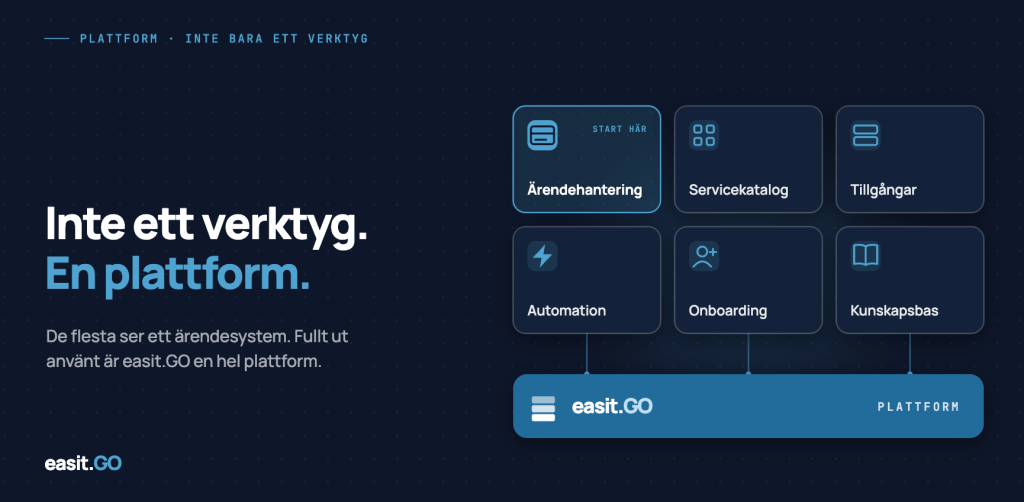
A case system is a tool for handling incoming requests. A platform is a common foundation on which the organization builds its processes. With its own case types, its own automation rules, its own integrations and its own reports.
Easit GO contains all the capabilities required for the platform mindset. A Design Studio where case types and flows are configured without code, a rules module for automation, API connections for integration with surrounding systems and a report layer for monitoring and control.
But the abilities themselves don't create value. It's how you choose to use them that does.
What separates platform users from system users?
Organizations that have come the furthest with Easit GO have a few things in common.
They have expanded beyond IT.
Most people start with IT support, but those who see the most value have added flows for HR, facilities, finance or other support functions. Not because it was planned from day one, but because they realized that the problems they were solving in IT support existed in the rest of the organization as well.
They have invested in automation.
Every manual step that can be automated is a step that frees up time and eliminates inconsistency. The organizations that have come the furthest have systematically reviewed their flows and asked: what of this can the system take care of?
They have built a service catalog.
A well-structured service catalog makes it clear to employees what they can ask for and from whom. It reduces misdirected cases, sets expectations for turnaround times, and is the basis for measurable SLA follow-up.
They follow up with data.
Reports and dashboards in Easit GO are based on case data, but the organizations that actively use them see them as management tools, not statistics. Which case types drive the most volume? Where is SLA compliance lacking? Where is the escalation rate highest?
Integrations that extend the platform
A platform does not live in isolation.
Easit GO can be integrated with Active Directory for automatic synchronization of users and permissions, with inventory systems to link cases to configuration units, with monitoring tools that trigger cases automatically upon alarm, with financial systems for invoicing, and with HR systems to initiate onboarding and offboarding flows based on employment data.
The integrations mean that Easit GO does not have to be the only source of data, but it can be the place where processes and flows live, with information pulled from the systems that own it.
It's the difference between an isolated case system and a platform that is an active part of the organization's digital infrastructure.
How you take the step from system to platform
The step does not require a major re-implementation. It requires a shift in perspective and a systematic approach.
Start by taking stock of which processes in the organization currently lack structural support. Cases that are handled via email, processes that live in spreadsheets, flows that depend on a specific person knowing how it works.
Choose one of them. Build a flow in Easit GO. Define the case type, set up automation rules, add measurable service levels.
Evaluate, adjust and repeat.
It is not a project with an end date. It is an ongoing management of a platform that grows as the organization's needs become clearer.
Frequently asked questions
What is the difference between a case system and a platform?
A case management system handles incoming requests. A platform is a common foundation for your organization's processes with its own case types, automation rules, integrations and reporting, tailored to your business's specific needs.
What can you build in Easit GO besides case management?
Service catalogs, automation flows, CMDB, onboarding and offboarding processes, SLA follow-up, dashboards and ESM flows for HR, facility, supplier management and finance, etc., configured without code via design studio.
How do you start using Easit GO as a platform?
Identify processes that lack structural support. Choose one, build a flow and add automation and reporting gradually. Platform thinking is a shift in perspective, it starts with asking what the system can do for you, not just what you do in the system.
The case system is the starting point. The platform is where you take your organization when you decide that structured service delivery is not just about IT support.
Would you like to see what Easit GO can do as a platform for your organization? Book a demo
Read more

Henrik Traveler
Commercial Product Manager
henrik.resare@easit.com
+46 70 249 36 06