Onboarding is the organization's most cross-departmental process and one of the most underestimated.
It's not enough for HR to send a welcome email and IT to prepare a computer. Without a coordinated flow where IT, HR and facilities work towards the same timeline, it's rare for a new employee to meet an entire organization on day one.
What actually happens without a coordinated flow
The scenario is familiar in most organizations.
HR registers a new hire, sends an employment contract and plans the induction programme. IT is informed of the arrival of a new employee by the manager three days before the start, via email. Facility activates an access card based on a printout from the HR system that is seven days old.
And the new employee sits on day one without access to the systems they need, without an access card that works for the right spaces and with a computer that is not configured for their role.
It's not because IT, HR or facilities are sloppy. It's because they work in separate systems, with separate processes and without a common flow that holds their work together.
Offboarding is worse, if possible. Studies consistently show that system access is not revoked in a timely manner upon termination of employment, in some cases accounts remain active for months. Not because anyone actively chooses to let it be that way, but because no single function has the big picture.
Why onboarding and offboarding are ESM issues
Onboarding and offboarding are not IT processes. They are not HR processes. They are organizational processes that require coordinated work from multiple functions, and that is exactly what Enterprise Service Management is designed for.
The ESM principle is that support functions deliver their services via a common platform with structured flows. For onboarding, this means that a request – “new employee starts July 22, role: system administrator, department: IT”, triggers a coordinated flow where each function sees its part, its tasks and its deadlines.
HR no longer creates a case in their system, sends an email to IT and hopes that the facility has received the information. There is a case, a flow and a consolidated status picture.
What a coordinated onboarding flow looks like in practice
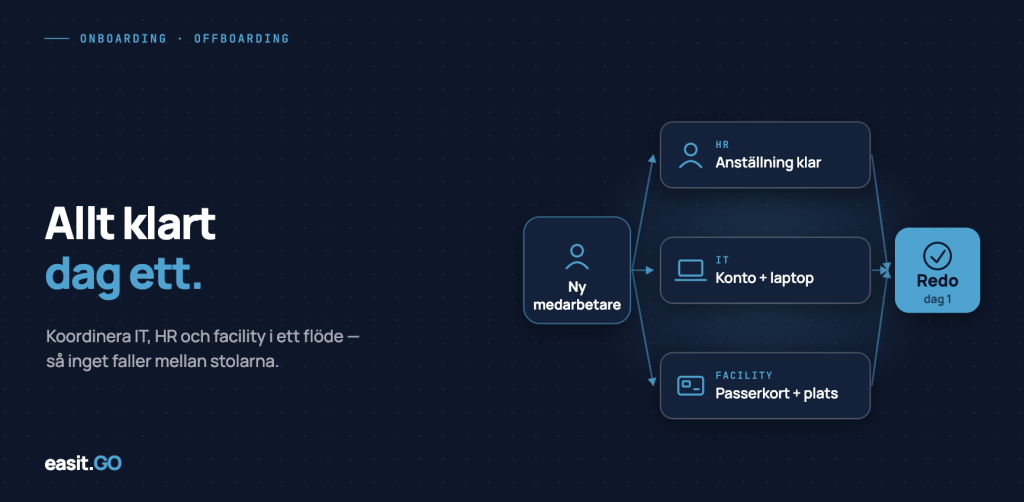
In Easit GO, an onboarding request can trigger parallel sub-issues for each involved function with their own responsible parties, their own deadlines and their own checklists.
The IT sub-learning includes tasks on configuring equipment, assigning system permissions and creating accounts. The Facility sub-learning handles access cards, workplace setup and any key or alarm tag. The HR sub-learning covers induction plans, contract documentation and information for the manager.
Each function only sees what they need to see and the manager has a comprehensive view of whether the onboarding is on track, without having to contact three separate departments for status updates.
Automation rules can be linked to time frames: if equipment is not ordered five days before the start date, a reminder is sent. If the access card is not activated the day before the start, the case is automatically escalated.
Offboarding requires the same structure – with stricter requirements
Offboarding is a process with safety requirements, not just logistics.
A structured offboarding process in Easit GO is triggered by a terminated employment and creates sub-cases for each return and deactivation that needs to be handled: equipment to IT, accesses to revoke, access cards to deactivate, any keys and permissions to document.
There's a timeline. There's ownership. There's a log of what was done and when.
The last point is more important than it may seem. In the event of a security incident or data protection audit, it is not enough to say “we usually handle it.” There needs to be documentation that system access was revoked no later than the date employment ended and who did it.
Three principles for a functioning flow
Organizations that succeed with coordinated onboarding and offboarding have a few things in common.
A single start trigger.
The process begins with a single request, not three separate emails to three separate departments. That request contains all the information each function needs.
Clear ownership per subtask.
Every task in the flow has a responsible function and a responsible person. No task is “in the air” without someone owning it.
Visibility without the need for contact.
The manager and the employee should be able to see the status of the entire onboarding process without having to call around. This reduces friction and creates security.
Frequently asked questions
Why doesn't onboarding work when IT, HR and facilities work in separate systems?
Each function sees its part of the process but not the whole. Without a coordinated flow, it is up to the manager or the new employee to keep three parallel processes together.
What are the risks of unstructured offboarding?
System access not revoked in a timely manner, equipment not returned, and lack of documentation of what was done and when. It's a security risk, a financial risk, and in some cases, a data protection issue.
How do you coordinate onboarding in Easit GO?
An onboarding request triggers parallel sub-tasks to IT, HR and facility with their own deadlines and responsible parties. Automation rules ensure that the right tasks are created at the right time, and the manager can follow the status in a consolidated view.
Onboarding and offboarding are the organization's calling cards – for new employees and for those who leave. Making them structured is not administrative puritanism. It is a way to show that the organization is working.
Want to see what onboarding and offboarding can look like in Easit GO? Book a demo
Read more

Henrik Traveler
Commercial Product Manager
henrik.resare@easit.com
+46 70 249 36 06