ITSM is a proven model. It helped IT departments move from reactive firefighting to structured service delivery with clear processes and measurable service levels.
But one thing has changed: the business places the same demands on HR, finance and facilities, etc. that it has long placed on IT. And most support functions are not equipped for that.
Why ITSM worked and why it's not enough
ITSM solved a real problem. Before structured IT processes were established, IT support was often chaotic. Cases were handled ad hoc, prioritization was based on who shouted the loudest, and there was no systematic follow-up of either volumes or quality.
ITIL and similar frameworks gave IT departments a common language and structure. Incident management, change management, configuration management, each process was given a defined purpose, ownership, and a way to be measured.
It worked. And it still works for IT.
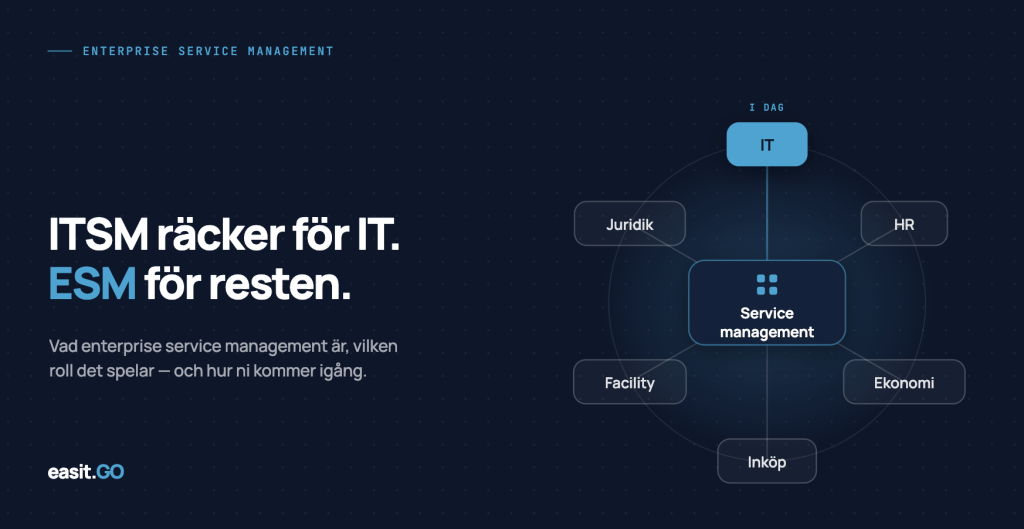
The problem is that the IT department is no longer the only support function that handles high case volume. HR receives questions about employment contracts, vacation rules and salaries. Finance handles certificates, purchase orders and invoice issues. Facility handles access cards, workplace bookings and error reports. Legal handles contract reviews and compliance issues.
All of these flows are ongoing but, often, without the structure that IT received twenty years ago.
What Enterprise Service Management means
Enterprise Service Management, ESM, means that the principles of ITSM are applied to the entire organization. Not just IT, but all support functions that deliver services to the business.
It's not about giving HR an IT system. It's about giving HR the tools and processes that allow them to deliver their services in a structured way with clear case flows, defined service levels and an experience for employees that is equivalent regardless of which function they turn to.
The principles are the same as in ITSM. Structured case management, clear ownership, measurable delivery, defined services and continuous improvement. What changes is the scope, from the IT department to the entire organization.
What happens when support functions lack structure
An organization where IT has ITSM but other support functions lack a corresponding structure looks recognizable.
HR handles cases via email and verbal inquiries. There is no systematic follow-up of processing times. Employees do not know who to contact for what, and cannot follow up on the status of their cases. New staff who are to be onboarded end up in a situation where access cards, computer equipment, system permissions and HR documentation are handled by three different functions without a cohesive flow.
Facility receives error reports via telephone and a mixed system of email and paper forms. There is no history. Recurring problems are never identified as such.
Finance handles certification and invoice matters in one system, purchase orders in another, and supplier communication in a third.
The result is inefficiency but above all an uneven experience. Employees who are used to structured IT support encounter something completely different when they contact HR or facilities.
One platform for the entire organization
The practical solution is a common platform where all support functions can manage their services with customized case types, flows and permissions per function, but with a common infrastructure and a common experience for users.
In Easit GO, this means that HR builds its case types for employment cases and onboarding. Finance builds its flows for certification and purchasing. Facility handles error reports and bookings. Each function configures its part of the platform based on its needs, but the employee meets one and the same place to submit cases, follow up on status and communicate with the administrator.
It reduces the administrative burden and gives each support function data about its own operations: processing times, case volumes, recurring problem types. Data that the IT department has long had access to in its ITSM systems.
How to get started with ESM
ESM is not a project that is implemented all at once. It is an expansion that takes place in stages, function by function, process by process.
The natural starting point is to identify which support function outside of IT handles the highest case volume and has the least structural support. Build a case type, define a flow, and set measurable service levels. Evaluate the results before expanding.
Organizations that succeed with ESM are those that don't try to do everything at once but rather those that start by asking the right questions. What processes are currently running without structural support? Where is the experience for employees the worst? Where is the most time lost in manual administration?
The answers to those questions are your ESM roadmap.
Frequently asked questions
What is Enterprise Service Management (ESM)?
ESM means that the principles of ITSM, structured service delivery, clear ownership, measurable service levels, are applied to the entire organization. HR, finance, facilities and other support functions manage their services with the same model and often on the same platform.
What is the difference between ITSM and ESM?
ITSM is designed for IT department service delivery. ESM extends the same principles to the entire organization. The difference is not technical, it is a matter of scope. ITSM manages IT services, ESM manages all services that support functions deliver to the business.
How do you get started with ESM?
Identify which support function outside of IT handles the highest case volume without structural support. Build a case type, define a flow, and set measurable service levels. Evaluate the results before expanding to the next function.
ITSM solved the IT department's problem. ESM solves the entire organization's. The difference is not a new system – it's that you use what you already have, in a broader way.
Do you want to see what ESM looks like in Easit GO in practice? Book a demo
Learn more

Henrik Traveler
Commercial Product Manager
henrik.resare@easit.com
+46 70 249 36 06