
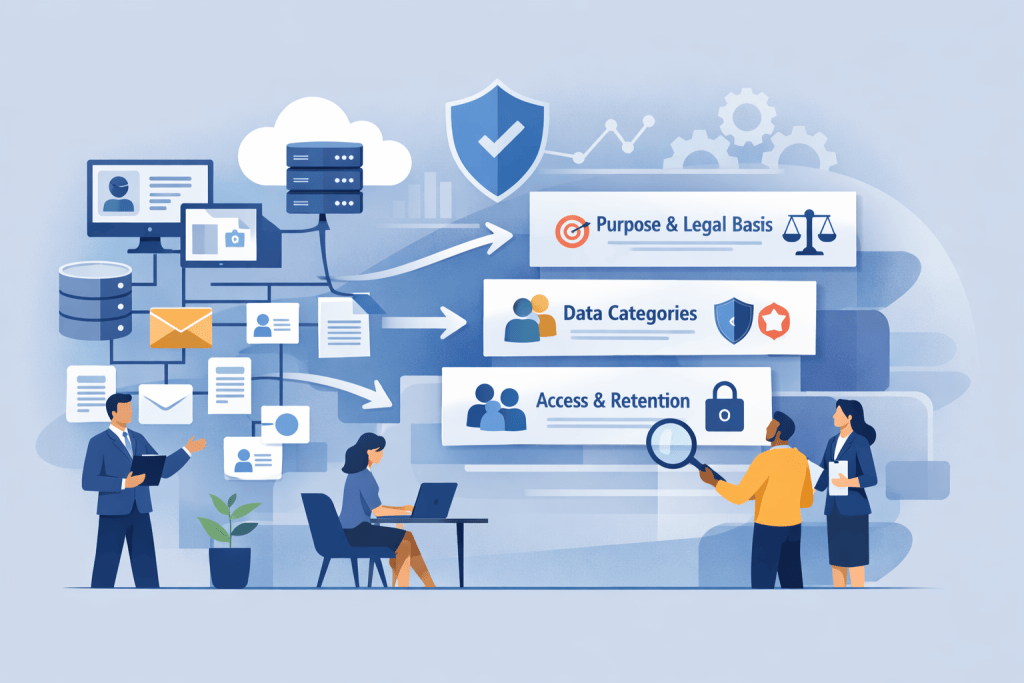
In discussions about NIS2, the focus often ends up being on technical security measures, incident management and continuity planning. However, a more fundamental question quickly emerges:
How does the organization keep track of what personal data is actually being processed and why?
The answer is often: the treatment registry.
The processing register is a requirement according to GDPR, but in practice it also functions as a cornerstone for mature work on information security, risk management and governance, areas that are also central to NIS2.
What is a treatment register?
A processing register (register of personal data processing) is a structured list of the organization's processing of personal data.
It does not describe technical storage or database content but the purpose, responsibility and risk associated with each processing.
A treatment register must contain information about, among other things:
- Purpose of the processing
- Categories of personal data
- Categories of data subjects
- Legal basis
- Recipients and any third-party transfers
- Storage time
- Technical and organizational protection measures
The register is thus a governing document at the operational level, not a technical inventory.
Why is the treatment register so important?
1. The basis for accountability
GDPR not only requires the organization to comply with the rules, but also to be able to demonstrate how.
The treatment register is usually among the first things requested during supervision or review.
2. Overview of actual personal data processing
Many organizations know which systems they use, but lack answers to:
- why the personal data is processed
- whether the treatment is still relevant
- whether it is proportionate to the purpose
The treatment register creates this overview.
3. Prerequisite for risk and impact assessments
Without a correct treatment record, it becomes difficult to:
- conduct DPIAs
- assess the consequences of personal data incidents
- prioritize the right security measures
There is a clear connection to NIS2 here, even though the requirement itself comes from GDPR.
The difference between data in a system and a treatment register
This is one of the most common misunderstandings.
Data in a system, application or service
- Actual data records and fields
- Technically stored information
- Often unstructured or scattered
- Requires technical expertise for analysis
Example:
- cases in a case management system
- user profiles in a portal
- logs, history and attachments
Treatment register
- Describes the processing, not the storage
- Technology-independent
- Structured by business processes
- Understandable for operations, legal and management
Example:
“Handling of citizen matters within technical administration”
The same treatment can:
- involve multiple systems
- contain different types of personal data
- have multiple roles and responsibilities
👉 A system can contain multiple treatments and a treatment can encompass multiple systems.
Treatment registers to support the NIS2 work
NIS2 requires:
- risk awareness
- traceability
- clear responsibility
- control of information flows
Although the processing register is formally a GDPR requirement, in practice it also serves as strategic support in the NIS2 work.
Without clear knowledge of:
- what personal data is processed
- in what contexts
- with what consequence in case of incident
It becomes difficult to determine which security measures are reasonable and proportionate.
How Easit GO can be used for treatment records
Support for treatment registers has existed in Easit GO for a long time, precisely because this is operational and continuous work – not a one-off document.
In Easit GO, organizations can, among other things:
Create treatment records as structured objects
Connect treatments to:
systems and services
processes
organizational responsibility
Ensure that the information complies with GDPR requirements
Use the register as a basis for:
risk analyses
internal control
follow-up and improvement
The result is a living treatment registry that supports both compliance and governance.
Summary
A processing register describes why and how personal data is processed.
It is not the same as data stored in a system
It is central to GDPR and an important support in the NIS2 work
With the right tools, it becomes an active control instrument, not an administrative burden
If you want to know more about this, get in touch and we'll go over how GO can help you and your business!
Read more
For those of you who want to delve deeper into related topics, tools and support, there are several good resources on Easit.se:
Immerse yourself in NIS2 compliance
NIS2 compliance with Easit GO – How the platform supports automated incident reporting, risk management and third-party verification according to NIS2 requirements.
Explore the features of Easit GO
Platform Features – An overview of everything Easit GO offers, including support for treatment records, personal data incidents, and consent management.
Related knowledge articles and blogs
From incident to report – how GO supports NIS2 requirements – Blog post focusing on incident management and reporting according to NIS2.
The new cybersecurity act - how your organization is affected - Article about the implementation of NIS2 in Swedish legislation and what it means in practice.
GDPR support in practice
System support for GDPR - training - Information about training for those who will work with thinning and de-identification in Easit GO, including practical tools for GDPR compliance.

Henrik Traveler
Commercial Product Manager
henrik.resare@easit.com
+46 70 249 36 06