
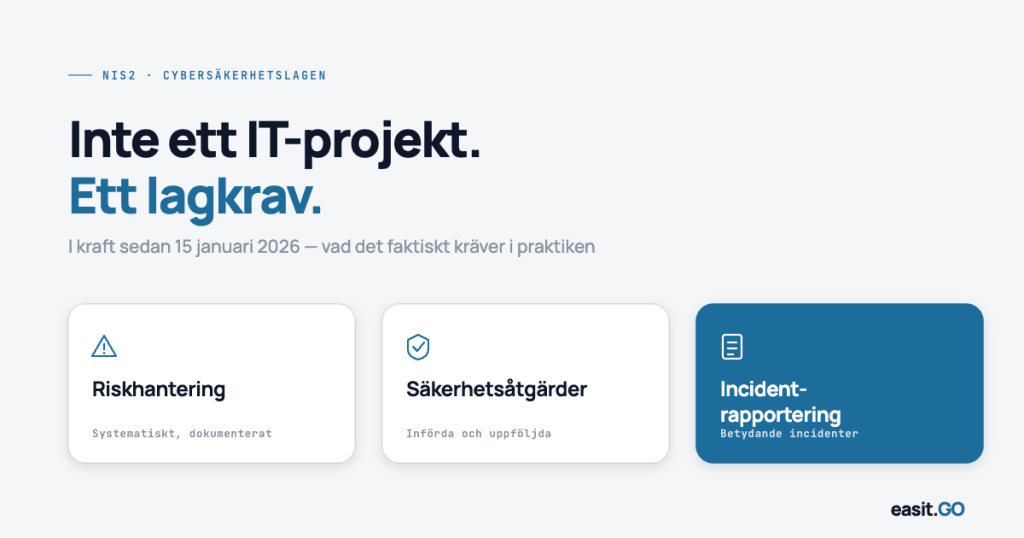
NIS2 is not an IT project. It is a legal requirement.
Since the Cybersecurity Act, which implements large parts of the NIS2 Directive, came into force, a large number of public and private operators are subject to requirements for risk management, security measures and reporting of significant incidents.
The problem is that NIS2 is often discussed on an abstract level: "we need to become compliant." What it actually requires in practice, and what demands it places on the IT systems that will support the work, is less often examined.
Who is affected by NIS2?
The Cybersecurity Act divides affected organizations into essential and important operators.
If your organization operates in any of the following areas, you are likely affected by NIS2:
- Public administration: municipalities and regions are covered in their entirety; for state authorities, exemptions apply to several categories — check if your authority is explicitly included
- Healthcare
- Digital infrastructure and digital services: cloud services, data centers, managed services and managed security services — not “IT services” in the broad sense
- Energy, transport, water and waste
NOTE: Each individual is responsible for determining whether the Cybersecurity Act applies to their organization. This article provides practical general guidance, not legal advice.
What the law specifically requires and what it means for your platform
The Cybersecurity Act specifies a number of categories of security measures. Below we map a selection to what this means in practice and what your service management platform can contribute.
The last two lines (*) are not explicit requirements but provide important practical support for meeting the other requirements.
NIS2 requirements | What it means | What it requires from your platform |
Risk analysis and risk management | Documented processes to identify, assess and manage cybersecurity risks on an ongoing basis. | Support for creating and following up on risk cases. Linking between risks, assets and actions. Documentable decisions with audit trails. |
Incident management | Systematic incident management — classification, escalation and reporting of significant incidents to the competent authority within established deadlines. | Structured flow for logging, classifying and escalating incidents. Timestamping and audit trail. Possibility to compile event sequences as a basis for regulatory reporting. |
Continuity and crisis management | Plans and procedures for maintaining operations in the event of disruptions — including backup and recovery of critical systems. | Ability to manage and follow up on actions in the event of operational disruptions. Documented procedures available and searchable in the system. |
Supply chain security | The security level of suppliers and service providers should be assessed and managed — including software and digital services. | Management of supplier relationships and agreements. Possibility to link requirements and follow-up to external parties in the system. |
Secure system development and maintenance | Security must be taken into account when acquiring, developing and maintaining network and information systems. | Change flow with approval steps and documentation — supports structured processes around system changes, even if change management itself is not an explicit legal requirement. |
Education and skills | Management must undergo training on cybersecurity risks and the meaning of the requirements (Chapter 2, Section 4 of the Cybersecurity Act). For personnel, training is included as one of the security measures to be taken. | Ability to log and document training efforts, manage policy documents and link competency requirements to roles in the system. |
Access control and asset management | Principles for least privilege (MFA) and inventory of critical assets. | Role-based authorization structure. Logging of logins and actions. Integration with AD/LDAP. |
Change management* | * Not an explicit requirement in legislation, but a natural support for risk analysis and continuity requirements. Changes to critical systems should be planned, approved and documented. | Change flow with approval steps and audit trails — a practical tool for keeping security work together internally. |
Asset inventory/CMDB* | * Not an explicit requirement in the legislation, but a necessary basis for risk analysis and supplier management. Without control over which systems and assets exist, it is difficult to meet other requirements. | CMDB function to record, classify and maintain information about system components and IT assets. Provides context for risk and incident management. |
Incident reporting: three steps and fixed deadlines
One of the clearest obligations in the law concerns reporting significant incidents. A “significant incident” is an incident that causes or may cause serious operational disruption, financial damage, or that affects or may affect other businesses or people through significant harm.
The law specifies three steps with fixed deadlines. The steps are: information/early warning, incident notification and final report. If the incident is ongoing when the deadline for the final report expires, a status report must be submitted instead. Reporting is made to the competent authority.
This makes structured incident management, time stamping and compilation capabilities important practical supports for reporting within deadlines. The final report should cover, among other things, the severity and impact of the incident, probable root cause and threat type, actions taken and, if necessary, cross-border impact.
A service management platform with structured incident management gives you that flow, but check that you can actually export and compile event sequences in a way that serves as a basis for regulatory reporting.
Supplier security: an issue for your platform provider
The law requires you to manage security risks in your supply chain, and that includes the provider of your service management platform.
It's a question that isn't always asked, but which the law makes mandatory: what level of security does the supplier of the systems you depend on have?
Specifically, this means that you should be able to answer the following about your platform provider:
- Where is your data physically stored, and under what jurisdiction do the provider and its parent company operate?
- What access do the supplier's staff and any subcontractors have to your data?
- What if the supplier suffers a security incident that affects you?
- Does the supplier have documented procedures for incident management and continuity, and can you see them?
- Are there dependencies on non-EU legislation that could affect your control over data or your business continuity?
A concrete risk factor to assess is the CLOUD Act: if the supplier, or its parent company, is subject to the US CLOUD Act, US authorities can, under certain circumstances, request data from the supplier's system, regardless of where the data is physically stored.
It is not an NIS2 requirement to store data in Sweden, but it is a risk that should be weighed proportionately against your dependencies, agreements and continuity needs. Easit GO is operated locally in the customer's environment or in our Swedish data center.
What to ask your current or prospective platform provider
Regardless of which system you use, you should be able to ask and get clear answers to these questions:
About data location and law
- Where is our data physically stored?
- Are you or your parent company subject to the CLOUD Act or equivalent non-EU legislation?
- Do you have a DPA (Data Processing Agreement)?
About incidents and availability
- What is your availability (SLA) and what happens if you break it?
- How do you handle a security incident on your platform that affects us?
- What procedures are in place to inform us in the event of a breach or data leak?
About NIS2 compliance functionality
- Does the platform have structured incident management with audit trails and export capabilities?
- Can we manage risk cases, asset inventory (CMDB) and change flows in the same system?
- Are access and actions logged in a way that can serve as a basis for audit?
- Does the platform support role-based authorization management?
About your own control
- Can we configure and manage the system internally without being dependent on you as a supplier?
- Can we export all our data if we choose to change provider?
The Cybersecurity Act as a reason to review your platform, not just your policy
Many organizations have started their work with policies and risk analyses. That's right. But the next step, ensuring that the systems that will support the work actually meet the requirements, is just as important.
A service management platform that lacks structured incident management, risk management support, access control, and audit trails makes compliance work harder, not easier. And a platform with unclear ownership or vague answers to questions about data location creates risks that should be actively managed.
This is not an argument for choosing Easit GO over alternatives. It is an argument for asking the right questions of the supplier you have, and of those you are evaluating.
Would you like to review how Easit GO supports your NIS2 work? We are happy to show you how incident flows, CMDB, change management and audit trails work in practice.
Read more
Why Swedish municipalities choose a European platform
About GDPR, NIS2 and the CLOUD Act — and what you should actually ask your supplier when purchasing.
What can you actually do with Easit GO?
Review of the breadth, flexibility, automations and integrations in the platform.
What is a CMDB — and why do you need one?
Configuration management as a basis for risk assessment and asset inventory.
This is how the platform approach works in Easit GO.
How a service management platform covers the needs of the entire organization — not just IT.

Henrik Traveler
Commercial Product Manager
henrik.resare@easit.com
+46 70 249 36 06