
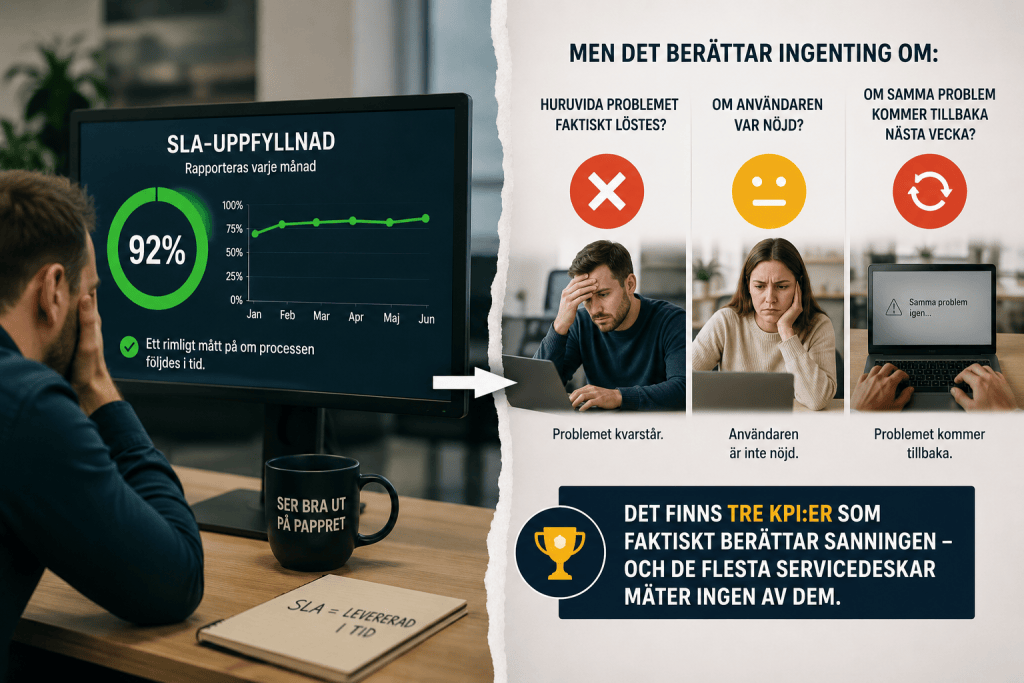
Most service desks report SLA fulfillment every month. It’s a reasonable measure of whether the process was followed on time. But it doesn’t tell you anything about whether the problem was actually resolved, whether the user was satisfied, or whether the same problem comes back next week. There are three KPIs that actually tell the truth, and many service desks don’t measure any of them.
What SLA fulfillment actually measures
SLA fulfillment is a process metric. It answers the question: did we close the case within the agreed timeframe?
It doesn't answer: was the problem resolved? Was the user satisfied? Do they need to contact us again with the same question?
It is possible to have 98% SLA fulfillment and still have a dysfunctional service desk. Cases can be closed before the problem is resolved so they don't miss the SLA. Cases can be closed without the user confirming that they are satisfied. And 30% of cases can be recurring versions of the same basic problem that are never fixed.
SLA is a good measure of whether the process is being followed. It is a poor measure of whether the service desk is actually doing the job.
Three metrics that provide a clearer picture
First Contact Resolution (FCR)
FCR measures the percentage of cases that are resolved on first contact, without feedback, without escalation, without being reopened.
It is the single strongest measure of service desk effectiveness. A high FCR means that agents have
- the right skills
- right access to information
- the right authority to resolve problems without passing them on.
It directly correlates with user satisfaction: nothing frustrates a user more than having to explain their problem over and over to different agents.
Industry average for FCR in IT service desks: 70–80%. If your FCR is below 60%, there is a systematic problem that the SLA report never reveals.
Customer Satisfaction Score (CSAT)
CSAT measures how satisfied the user is with the case management. For example, a short survey, with a few questions, that is sent out automatically when a case is closed.
The critical thing about CSAT is that it measures the experience, not just the outcome. An incident may technically be resolved, SLA met, and FCR recorded – but if communication was poor, if the agent seemed disinterested, or if it took too long to understand the problem, the user will give it a low rating.
CSAT data is also invaluable for coaching agents: it identifies specific people and case types that generate dissatisfaction, which is not evident from quantitative metrics.
“Case age”
Case age measures how long cases have been open before they are closed
Most service desks have a constant pool of cases that remain open week after week. They are not urgent enough to be prioritized, but they are also never completed enough to be closed. They are forgotten, never escalated, and do not always tell their full story in the SLA report – because the SLA report measures closed cases within or outside the SLA.
Case age reveals the cases that have failed the system. It identifies resource bottlenecks: if all cases older than 30 days belong to the same caseworker group, there is a capacity problem that management has never seen.
How to measure these KPIs in Easit GO
Easit GO's reporting functions give you access to the metrics that actually tell the truth directly from the process.
FCR: Configure a closure code for “Resolved on First Contact” and build a view or report that measures the proportion of cases with this status per period, per case manager group, and per case type.
CSAT: Easit GO can trigger automatic follow-up surveys when a case is closed. The responses are linked to the case and the caseworker. The reports provide aggregated CSAT data by team, by case type, by time period, service, etc.
Case Age: Filter open cases by creation date and sort ascending. Add a view that always shows the 10 cases that have been open the longest. It's a report that takes five minutes to set up and will change how you prioritize permanently.
Why it matters to measure correctly
Metrics drive behavior. If a service desk is evaluated solely on SLA fulfillment, agents learn to prioritize speed over quality. Cases are closed on time but not necessarily with the right outcome.
Add FCR to the evaluation and behavior changes: case managers stop forwarding cases unnecessarily, start searching for information more thoroughly, and take responsibility for actually solving the problem.
It's not a technical change. It's a change of mindset and strategy.
Frequently asked questions
What is First Contact Resolution? FCR measures the percentage of cases that are resolved on first contact without feedback or escalation. It is the strongest measure of service desk effectiveness and directly correlates with user satisfaction.
Why isn't SLA fulfillment enough? SLA measures whether the case was closed on time – not whether the problem was solved or whether the user was satisfied. It is a process measure, not a quality measure.
What is case age? Case age measures how long open cases have been unresolved. Old open cases are a sign of misallocated resources or systemic problems that are never addressed.
Can Easit GO measure FCR and CSAT automatically? Yes. FCR is configured as a closure code and measured in the reports. CSAT is triggered as an automatic follow-up survey when a case is closed and is linked to the case manager and case type.
SLA fulfillment is a good starting metric. But it's not enough to understand if your service desk is actually working. FCR, CSAT and case age tell the truth – and all three can be measured in Easit GO without additional modules.
Want to see what the reports look like in Easit GO? Book a demo
Read also: Most people measure cases – but not what they cost

Henrik Traveler
Commercial Product Manager
henrik.resare@easit.com
+46 70 249 36 06