
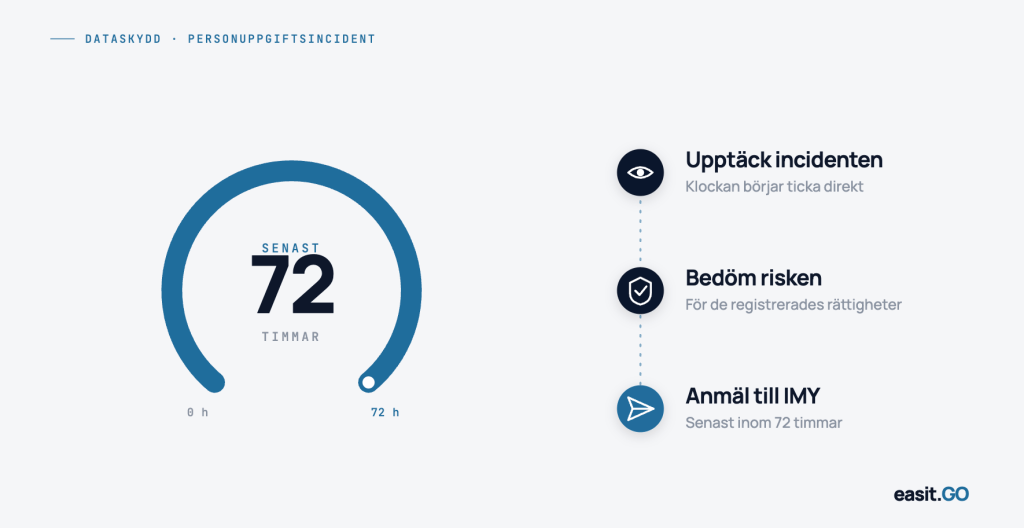
The clock starts ticking when you become aware of a personal data breach. If the incident is likely to pose a risk to the rights and freedoms of data subjects, it must be reported to IMY without undue delay and no later than 72 hours. The organizations that can do this are those that have a process in place before anything happens.
What is a personal data breach?
The definition is broader than many people think.
A personal data breach is any security incident that leads to the accidental or unlawful destruction, loss, alteration, unauthorized disclosure of, or unauthorized access to personal data. It includes:
- Data breach where an external actor has accessed personal data
- Misdirected email with personal information to the wrong recipient
- Lost device with unencrypted sensitive information
- Incorrect permission settings that gave unauthorized access
- Accidental deletion of personal data that cannot be restored
- Ransomware attacks that lock down systems with personal data
Common to all, they concern personal data, and they require an assessment of whether and how they should be handled and reported.
What needs to be done and within what time frame
GDPR sets three requirements that are activated in different situations:
1. Internal documentation – always
Every personal data incident should be documented internally, regardless of whether it is reported or not. The documentation should include the nature of the incident, the categories and approximate number of data subjects affected, the likely consequences, and the actions you have taken or plan to take.
The idea behind the requirement is that you should be able to demonstrate to IMY that you handle incidents systematically, even those that are not reported.
2. Reporting to IMY – within 72 hours
If the incident is not unlikely to result in a risk to the rights and freedoms of data subjects, you must report it to IMY. This is done via IMY's reporting service and must be done without undue delay and at the latest within 72 hours of becoming aware of it.
You do not need to have all the information ready within 72 hours. A preliminary notification with the information you know is acceptable, but the delay must be justified and you will supplement it later.
3. Information to data subjects – in case of high risk
If the incident is likely to pose a high risk to the rights of the people affected, you should also inform them immediately. You should describe what happened, the consequences and what you are doing about it in clear and simple language.
Why the process needs to be in place before it happens
72 hours is enough if you know what to do. It is not enough if you start by finding out who is the data controller, where the processing register is located, which systems are affected and who should be informed.
The information you need to handle an incident quickly and correctly is the information you should have documented beforehand:
- Your processing register: what categories of personal data do you process, in which systems and for what reasons?
- Your system mapping: which systems handle personal data and how are they connected?
- Your contact details: who is the data controller, is there a data protection officer?
- Your access logs: who had access to what, and when?
What we have written about in recent weeks – the treatment register, information classification and authorization management, management plans and system mapping – are not separate compliance exercises. They are the documentation that makes it possible to act quickly and correctly when something happens.
Incident management in Easit GO
In Easit GO, you build a case type for personal data incidents with the fields normally needed to document a personal data incident according to GDPR: the nature and date of the incident, the categories affected and the approximate number of data subjects, whether the data was encrypted or not, the risk assessment and the action plan you have decided on.
The case timeline automatically documents every action, who logged what, when the assessment was made, when IMY was contacted. This gives you a complete audit log without requiring manual annotation.
The case is linked directly to relevant objects in your system mapping and to the relevant records in the treatment register. You don't have to look up the context in the middle of a crisis - it's already linked.
Automation rules can trigger escalations and reminders: if an incident case has not received an initial assessment within six hours, if reporting to IMY has not been logged before the 60-hour mark, if the data subjects should be informed and no action has been documented.
Frequently asked questions
What is a personal data breach?
Any security incident that leads to the accidental or unauthorized access, loss, destruction or disclosure of personal data. Not just data breaches – also misdirected emails, lost devices and incorrect permission settings count.
Do all incidents have to be reported to IMY?
No. You report unless it is unlikely that the incident poses a risk to the rights of the data subjects. If the risk is deemed unlikely, you document it internally and do not report. However, the assessment and the reasons for it should always be documented.
What applies within 72 hours?
If it is not unlikely that the incident poses a risk to the rights of data subjects, you must report it to IMY without undue delay and at the latest within 72 hours of becoming aware of it. A preliminary report with the information you have is acceptable - any delay must be justified.
How do you handle this in Easit GO?
A case type with the fields normally needed to document a personal data incident according to GDPR, automatic timeline, connection to processing registers and system objects, and automation rules that keep track of deadlines for you.
What determines whether 72 hours is enough is not what happens in those 72 hours. It's what you did in the months and years leading up to the incident.
Would you like to see how incident management and compliance documentation can be handled in Easit GO? Book a demo
Read more!
- System mapping in Easit GO: Do you know what systems you have and who owns them?
- Management plan in Easit GO: Structure system management so that it is actually used
- Information classification and access management: Do you know who has access to what?
- Treatment register: What it is, why it is important and how it relates to GDPR and NIS2
- Platform features

Henrik Traveler
Commercial Product Manager
henrik.resare@easit.com
+46 70 249 36 06