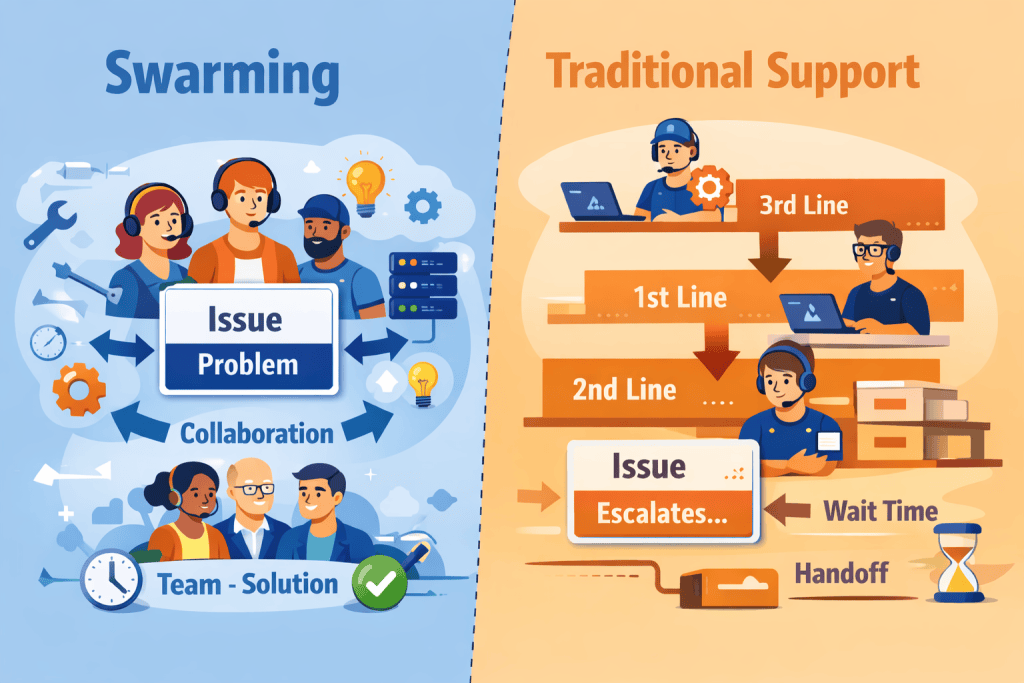
The traditional model of first, second and third line support has long been the norm in IT and business support. It is based on a clear division of responsibilities where cases are handled in stages, often with a focus on triage, prioritization and escalation. For many organizations, this has worked well, especially in environments where case types are relatively simple, predictable and easy to categorize.
The problem arises when reality no longer fits the model.
In a classic tier structure, the first line is often designed to handle volume. Cases are received, registered and resolved to the extent possible. If the competence is not sufficient, the case is passed on to the next level. However, each handover means that context is at risk of being lost. The user has to wait, agents are replaced and the same questions may have to be asked several times. The model is effective, but mainly when cases are clearly delimited.
Swarming takes a completely different approach.
Instead of a case wandering between levels, the right expertise is gathered around the case as early as possible. The focus is not on where in the organization the case belongs, but on how it can best be resolved. A case can initially be received by one person, but quickly supplemented with more perspectives, technical, business-related or process-related, without it being formally escalated.
The difference is clearly visible in how responsibility is perceived. In a tier-based model, each level “owns” the case until it is passed on. In swarming, responsibility is shared. The goal is not to complete one’s part, but to solve the whole. This often creates shorter lead times, fewer misunderstandings and a better experience for the person who reported the problem.
Another important difference is how knowledge is disseminated. In classic support, specialist knowledge is often built up at higher levels, while the first line risks becoming a burden rather than a learning experience. With swarming, knowledge transfer occurs continuously. More people see the whole case, more people understand the context, and the organization becomes less vulnerable to key people.
That doesn't mean swarming is always the right choice
For simple, repetitive cases, a clear first line with a high degree of automation can be both faster and more cost-effective. The great strength lies in the ability to combine working methods. To allow simple cases to flow efficiently, while more complex issues are handled collaboratively.
This is where many organizations stand today. Not in the choice between old and new, but in the need for flexibility. The ability to determine when a matter should be handled linearly, and when it should be solved through collaboration, is becoming increasingly important.
A modern case management system therefore needs to not only support queues and levels, but also enable dynamic teams, shared responsibility, and transparency.
Easit GO is built for exactly this. The platform does not lock the organization into a certain structure, but makes it possible to work with both classic tier support and swarming. Sometimes in parallel, sometimes in combination, but always based on the needs of the business.
Read more about how Easit GO supports modern support and service management
Easit GO is a flexible and adaptable service and process management platform that helps organizations work more efficiently with everything from ITSM processes to customer service and internal support. The system offers complete support for case and issue management, incident management, problem management, change management and more, making it possible to handle both standardized issues and more complex scenarios that favor collaborative working methods such as swarming.
The platform's flexibility and broad functional support make it easy to adapt solutions to the needs of the business - regardless of whether it concerns the IT department's service management, customer service or digitalization of internal processes.
If you want to explore how Easit GO can be used in practice within different parts of an organization, there are specific pages with examples and solutions, for example for customer service, IT support and municipalities - where the system's adaptability and centralized process management really come into their own.
Explore more about GO

Henrik Traveler
Commercial Product Manager
henrik.resare@easit.com
+46 70 249 36 06