
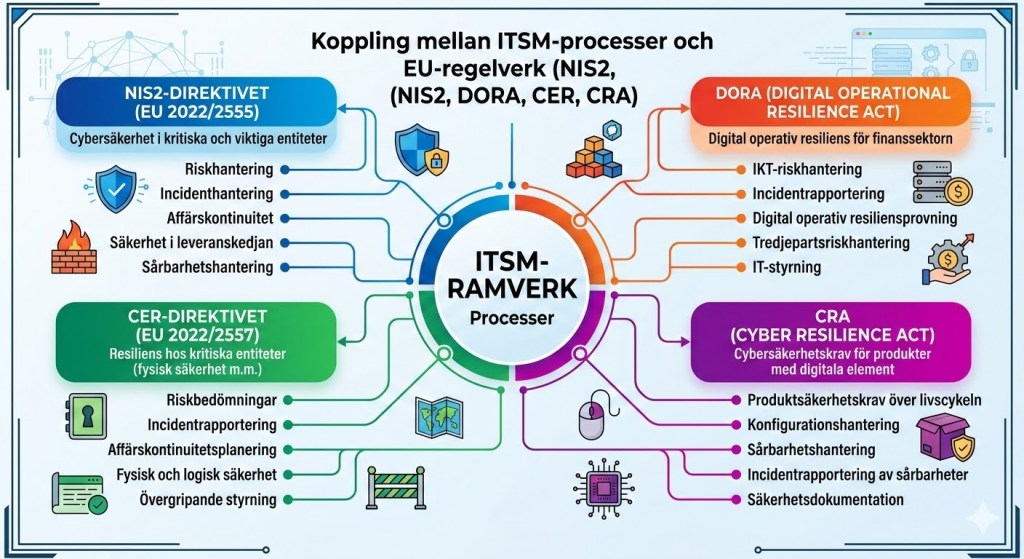
The EU's cybersecurity and critical infrastructure regulations place high demands on organizations, but many fail to realize that the answer to a large part of these requirements is already in their existing ITSM processes. This article explains what NIS2, DORA, CER and CRA mean, why they were created, and how IT Service Management serves as a practical framework to meet the requirements.
Quick facts: Four regulatory frameworks – a common pattern
Regulations | Who is affected? | ITSM connection | Status |
NIS2 | Publicly important & digital infrastructure | Incident mgmt, risk management, continuity | Valid now |
DORA | Financial sector | Incident mgmt, supplier management, testing | Valid now |
CER | Critical infrastructure | Continuity, crisis management, incident reporting | Valid now |
CRA | Digital product manufacturers | Vulnerability management, patch management, SBOM | Phase-in 2026–2027 |
Why all these regulations right now?
Geopolitical instability, increased cybercrime and critical infrastructure incidents have forced the EU to act. The NIS2, DORA, CER and CRA frameworks are all part of the same strategic initiative, to make Europe more resilient digitally and physically.
What all four have in common is that they are not satisfied with technology. They require processes, documentation, accountability and continuous improvement – which is exactly what ITSM is all about.
NIS2 – Network and Information Security
What is it?
NIS2 (Network and Information Security Directive 2) is the EU's directive for cybersecurity in critical services. It replaced the older NIS Directive in 2023 and greatly expands the scope of organizations covered.
Is your organization affected? NIS2 applies to organizations in sectors such as energy, transport, healthcare, public administration, digital infrastructure, water and food – with more than 50 employees or more than 10 million euros in turnover.
What does NIS2 require?
NIS2 – core requirements • Risk management and security measures proportionate to the risk of the business • Incident reporting: serious incidents should be reported within 24 hours (preliminary) and 72 hours (complete) • Continuity planning and crisis management • Supplier and chain security • Management responsibility |
The connection to ITSM
NIS2 requirements are largely procedural and ITSM is a process control framework. Incident management, problem management, configuration management (CMDB) and continuity planning are all established ITSM disciplines that directly address NIS2 requirements.
- Incident management ensures that serious incidents are identified, classified and escalated according to directive deadlines
- CMDB provides the system overview needed for risk assessment
- Continuity procedures (e.g. recovery plans) meet the requirement for resilience
- Supplier databases and contract management manage chain security
DORA – Digital Operational Resilience for the Financial Sector
What is it?
DORA (Digital Operational Resilience Act) is the EU regulation that applies to the financial sector. Unlike NIS2, DORA is a regulation – it applies directly in all EU countries without national implementation.
Is your organization affected? Banks, insurance companies, securities companies, payment institutions, credit rating agencies, crowdfunding platforms and their critical IT suppliers (so-called CTPP – Critical Third-Party Providers).
What does DORA require?
DORA – key requirements • ICT Risk Management Framework – a documented framework for IT risk management • Classification and reporting of serious IT incidents to the regulatory authority • Regular Digital operational resilience testing • Governance of third-party IT suppliers with contractual requirements and risk classification • Information sharing about cyber threats with industry colleagues |
The connection to ITSM
DORA is in many ways the most ITSM-intensive regulatory framework of the four. Almost every article in DORA can be mapped to an established ITSM process.
- ICT Risk Management requires a structured way to manage risks associated with IT systems – directly mapped to the ITSM risk management process and CMDB
- Incident classification and reporting require clear categories, severity assessments and escalation paths – the core of incident management
- Supplier governance requires a register of all critical IT suppliers with risk assessment – direct support from ITSM's supplier management
Resilience testing requires planning, follow-up and documentation – handled naturally in ITSM's change and release management
CER – Critical Infrastructure and Physical Resilience
What is it?
CER (Critical Entities Resilience Directive) is the EU's directive to protect critical infrastructure, not only digitally but also physically.
Is your organization affected? Organizations in energy, transportation, banking, drinking water, wastewater, digital infrastructure, public administration and the space sector.
What does CER require?
CER – core requirements • Risk assessment of threats to critical infrastructure (physical and digital) • Measures to prevent, mitigate and recover from disruptions • Incident reporting to national authorities • Background checks on personnel in sensitive roles • Collaboration between public and private sectors |
The connection to ITSM
CER focuses more on continuity and resilience than on cybersecurity specifically. ITSM's ITSCM (IT Service Continuity Management) and Business Continuity Management are the primary processes that meet CER's requirements.
- IT service continuity plans provide support for maintaining critical functions in the event of disruption
- The incident management process ensures rapid reporting and structured handling of serious events
- Change management minimizes the risk of unplanned disruptions in critical infrastructure
CRA – Cybersecurity for digital products
What is it?
The CRA (Cyber Resilience Act) is the EU regulation that sets security requirements for digital products and services, from industrial IoT to consumer products with network connectivity.
Is your organization affected? Manufacturers, importers and distributors of products with digital elements – hardware, software and anything that communicates in a network.
What does the CRA require?
CRA – core requirements • Security-by-design and security-by-default in product development • Vulnerability management throughout the product lifecycle • SBOM (Software Bill of Materials) – a list of all software components • Reporting of actively exploited within 24 hours • Security updates and patch management for at least five years |
The connection to ITSM
CRA is the regulatory framework that most clearly requires an interaction between product development and ITSM. Vulnerability management, patch management, and incident reporting are ITSM processes that directly support CRA compliance.
- Vulnerability management and patch management are established ITSM processes that CRA requires to be formalized and documented
- CMDB and SBOM complement each other – a well-maintained configuration database is the foundation for keeping track of software components
- The incident management process provides structure for the reporting obligations required by the CRA in the event of actively exploited vulnerabilities
ITSM as a hub in regulatory compliance
It is easy to view NIS2, DORA, CER and CRA as separate compliance projects with different requirements, timelines and responsibilities. But this is a costly and inefficient approach.
If we instead look at the regulations as a coherent set of requirements for systematic IT governance, a clear pattern emerges. Almost all requirements can be met by well-implemented ITSM processes.
The six ITSM processes that bear the brunt of the burden
- Incident Management – reporting, classification and escalation according to regulatory deadlines
- Problem Management – root cause analysis and systematic reduction of recurring incidents
- Change & Release Management – controlled changes that minimize risk
- Configuration Management (CMDB) – complete system overview as a basis for risk assessment
- IT Service Continuity Management – plans and capabilities to handle severe disruptions
- Supplier Management – governance and risk classification of third-party suppliers
Organizations that already work structured with ITSM have an advantage. They rarely need to build new ones – they need to document, fine-tune and possibly expand their existing processes to meet the specific requirements of the regulations.
For organizations that have not yet implemented structured ITSM, the regulations themselves are a strong argument: it is no longer an option to work unsystematically with IT governance.
Frequently asked questions
Do we have to implement all four regulations?
Not necessarily. Which ones apply depends on your sector and size. Many organizations are affected by NIS2 and possibly CER, while DORA is sector-specific for finance and CRA primarily applies to manufacturers of digital products.
We already have ITIL – is that enough?
ITIL is an excellent framework and covers the processes that the regulations require. However, ITIL in itself does not provide regulatory compliance – the crucial thing is that the processes are actually implemented, documented and that evidence of compliance can be presented to regulators.
What is the most common deficiency we see?
That processes exist on paper but not in practice. Regulations require demonstrable compliance – logging, documentation, traceability and reports. A modern ITSM tool that automates these parts of documentation is often the difference between passing an audit and not doing so.
Where do we start?
Start with a gap analysis: map out which regulations apply to you, and which of your existing ITSM processes already meet the requirements. This provides a prioritized action plan without reinventing the wheel.

Henrik Traveler
Commercial Product Manager
henrik.resare@easit.com
+46 70 249 36 06