ITIL processes, structured case management and data place: what municipal IT really needs from its ITSM platform
Municipal IT has never had an easy task. The system landscapes are broad, the users are spread from schools to social administration, and the demands for transparency and documentation are stricter than in most private businesses. For those organizations that have taken the step towards structured IT service management, the right ITSM platform proves to make a big difference, not just for the IT department but for the entire business.
IT service management, ITSM, is about delivering IT services in a structured and measurable way. In practice, this means that issues are handled the same every time, that changes are documented before they are implemented, that assets are inventoried, and that citizens and employees know where to turn when something doesn't work. ITIL, the globally used framework for ITSM, provides the structure and terminology to build this.
This article is about what municipal IT specifically needs from an ITSM platform, which ITIL processes are most relevant for municipalities and why choosing a Swedish supplier with deep public sector experience plays a role in that context.
What is ITSM and why is it right for municipalities?
ITSM is not a tool, it is a way of working. It is based on the idea that the IT department's task is to deliver services to the business in a predictable and documented way. In a municipal context, it is especially relevant for several reasons.
The municipality has a broad internal customer base: teachers, social workers, administrators and technical staff all have different needs and different IT dependencies. A structured ITSM approach makes it possible to manage these different needs with common processes, without having to build separate systems for each administration.
It's also about accountability. In public operations, it's important to be able to show how a case was handled, who made which decision, and when a change was implemented. An ITSM platform provides the audit log and documentation that the principle of openness and internal requirements require.
The most important ITIL processes for municipal IT
Not all ITIL processes are equally relevant in a municipal context. Below are the processes that municipal IT departments typically start with and that provide the greatest immediate value.
ITIL process | What it means in municipal IT | What the platform needs to support |
Incident management | Something doesn't work. The user reports. IT solves. The municipality often has high volumes and a broad user group. | Structured reception, prioritization, escalation and communication to the user. SLA follow-up. |
Service requests | Authorization to a system, new computer, password reset. Predictable tasks that should flow automatically. | Self-service service catalog. Automated approval flows. Reduces the burden on IT. |
Problem management | Recurring incidents with the same root cause. It is important to find and eliminate the underlying problem. | Linking incidents to problems. Root cause analysis. Follow-up of known errors. |
Change management | System upgrades, configuration changes, new infrastructure. Errors at the wrong time create major consequences. | RFC flow with approval. Classification of risk level. Feedback after implemented change. |
CMDB and asset management | The municipality owns hundreds or thousands of IT assets. Inventory is a prerequisite for control. | Structured CMDB with relationships between CIs. Import from discovery tools. Link to incidents and changes. |
Service catalog | Employees need to know what IT offers and how to order it. Clarity reduces false expectations. | Self-service portal with searchable catalog. Order flows with approval. Visible delivery status. |
Knowledge management | Reuse of solutions. Employees and users should be able to solve simpler problems themselves. | Integrated knowledge base linked to cases. Searchable for end users. Easy to create and update articles. |
A mature municipal IT department works on most of these processes in parallel. An ITSM platform that supports them with built-in functionality, without requiring extensive customization or external add-ons, delivers faster time to value and lower total cost of ownership.
The maturity ladder: where is your IT department?
Municipalities are at different points in their ITSM journey. Some still handle issues in emails and spreadsheets. Others have a system but lack structured processes. Some have come a long way with ITIL and are working on continuous improvement. The choice of platform should reflect where you are and where you want to go.
A typical maturity ladder for municipal IT looks like this:
- Level 1: Reactive. Cases are handled ad hoc, via email or telephone. No systematic approach.
- Level 2: Structured. A case management system is in place. Incidents and service requests are separated.
- Level 3: Process-oriented. ITIL processes are defined and followed. SLAs are measured and reported.
- Level 4: Optimized. CMDB is up to date. Problem management prevents incidents. Self-service reduces volume.
- Level 5: Continuous improvement. Data drives decisions. Processes are regularly revised based on measurement results.
A well-configured ITSM platform is crucial to moving from level 2 to level 3 and 4. Without the right tools, it is difficult to keep processes alive; they tend to fall back into the email habit of IT staff.
Why a Swedish ITSM system makes a difference
There are a large number of ITSM platforms on the market. Most are built for a global market and have strong AI features, broad integration and international support. However, for municipal IT in Sweden, there are a number of additional requirements that are rarely seen in product demonstrations.
The first is data location. The municipality handles personal data about residents, children, patients and socially vulnerable people. GDPR and the Data Protection Act require that data be processed correctly. An ITSM platform that is operated in Sweden, with a supplier without connection to foreign legislation such as the US CLOUD Act, simplifies compliance and significantly reduces legal risk.
The second is the Cybersecurity Act. Since the law came into force on January 15, 2026, it has imposed requirements for incident management, risk analysis and supply chain security. An ITSM platform is central to meeting these requirements, and a vendor who is familiar with the legal requirement can help you configure the platform in a way that supports compliance.
The third is local understanding. Municipal IT in Sweden follows patterns and requirements that are not obvious to international suppliers: LOU procurement, the principle of public access, the requirements of the Archives Act, integrations with Swedish systems and an organization where IT serves everything from preschool to elderly care. A Swedish supplier with extensive experience in the public sector understands these conditions from day one.
Easit GO as an ITSM platform for municipalities
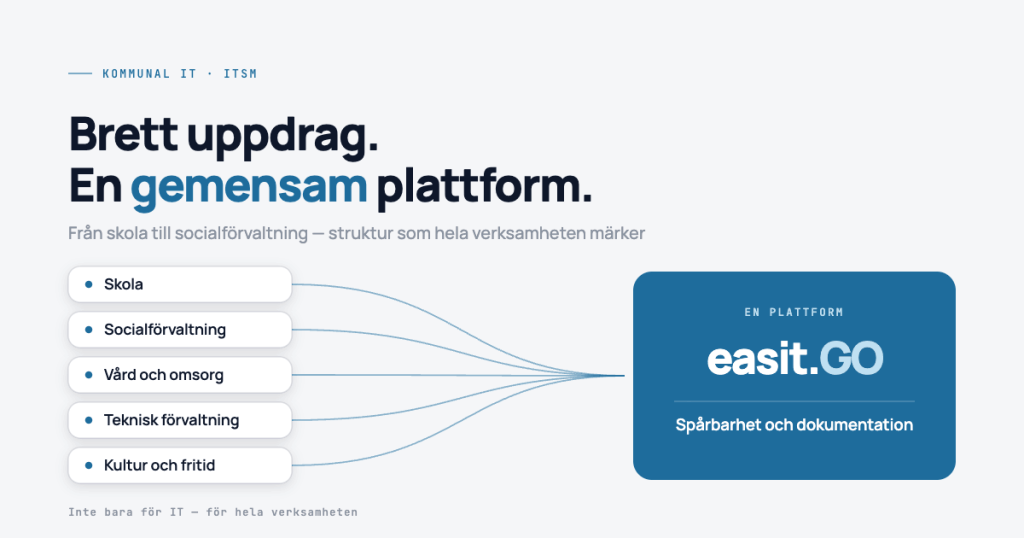
Easit GO is a case management system and service management platform built in Sweden, with extensive experience in municipalities, regions and government agencies. The platform supports the core ITIL processes with built-in functionality and is configurable without programming skills.
This means, among other things:
- Incident management with prioritization, escalation, SLA follow-up and communication to end users
- Service requests via a customizable self-service portal with order flows
- Problem management with linking to incidents and follow-up of root causes
- RFC flows for change management with risk classification and approval process
- CMDB with support for CI relationships, asset import and connection to other processes
- Service catalog with attestation flows and automatic deliveries
- Knowledge management integrated with the case flow, searchable for end users
- Reports and dashboards that measure SLA fulfillment, volume, and process health
The platform is operated on servers in Sweden or on-premises, support is provided in Swedish and implementation projects are run by consultants with experience in municipal operations. This means that you don't have to explain what a committee is, how LOU affects the contract structure or why the social administration's requirements look different than the technical administration's.
Structured IT service management makes municipal IT more predictable, measurable and sustainable. The ITIL processes provide the tools and language to build an IT department that delivers consistent service to the entire municipality's broad organization.
For Swedish municipalities, additional requirements strengthen the argument for a Swedish ITSM platform: data location and legal sovereignty, support for the Cybersecurity Act, and a supplier that understands the public sector's unique conditions without having to be explained.
Choosing an ITSM platform is a decision that will affect the IT department's daily life for many years to come. It pays to choose a platform that actually fits your business, not one that requires you to adapt to it.

Henrik Traveler
Commercial Product Manager
henrik.resare@easit.com
+46 70 249 36 06