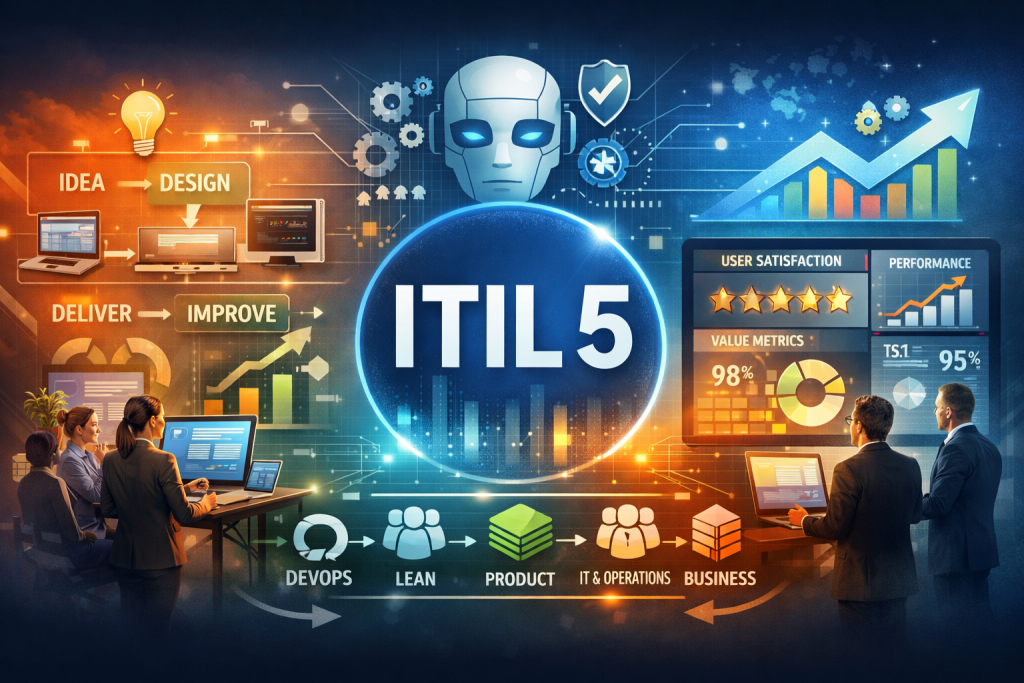
ITIL 5 is the next step in the evolution of ITIL and builds on previous versions to meet today's demands for digitalization, rapid change and increased automation. The focus is on how organizations can create, deliver and improve digital products and services with a clearer connection to value, experience and business benefit.
Unlike previous versions, ITIL 5 is adapted for organizations that work more cross-functionally, product-oriented and in environments where AI and automation have become a natural part of everyday life.
From IT services to digital products and value flows
A key development in ITIL 5 is a broader perspective on service management. The focus shifts from individual IT services to digital products, services and value streams that are managed in a coherent end-to-end perspective. From ideation and design to delivery, operation and continuous improvement.
Example
Instead of viewing IT support as an isolated function, the organization can view the digital workplace as a value stream. Onboarding new employees, access, tools, support, and continuous improvements are seen as parts of the same whole.
AI and automation as an integral part of the framework
ITIL 5 is described as AI-native, meaning that the framework is tailored for organizations that use AI and automation in their processes. The emphasis is on being able to introduce and scale AI in a responsible and controlled manner, with a focus on transparency, governance and quality.
Example
A service desk uses AI to suggest case categories and next steps, while also providing clear guidelines for when a human agent should make decisions and how AI support is followed up over time.
Increased focus on value, experience and business results
In ITIL 5, service management is even more clearly linked to real value creation. User experience, customer experience and business results become central perspectives when services and products are planned, delivered and improved.
Example
Instead of just measuring how quickly a case is closed, the organization measures how quickly a user can return to work and what the support experience actually was like.
Service management for the entire organization
ITIL 5 is not just aimed at IT support functions, but is intended to work across the entire organization. The framework interacts with agile working methods, DevOps, Lean and product development and provides a common language for management, operations and technology.
Example
Development teams, operations, support, and operations use the same structure to plan and follow up on a digital service, reducing silos and improving collaboration.
A further development – not a replacement
ITIL 5 is an evolution rather than a revolution. The fundamental principles of ITIL 4 live on and the implementation is gradual. Organizations already working according to ITIL 4 can therefore build on existing working methods and gradually adopt new perspectives.
Example
Incident and change management can continue to function as before, but is complemented by a clearer focus on lifecycle, value streams and experience where it has the greatest impact.
Summary
ITIL 5 reflects how service management needs to function in a modern, digital organization. With a stronger focus on value, experience, digital products and AI-enhanced working methods, the framework supports combining structure with development capabilities.
For many, ITIL 5 is therefore less about introducing something completely new and more about updating the view of how value is created and improved over time.
Read more about ITIL in our e-guides
Designing and maintaining a service catalog in practice
Learn how to build and manage a service catalog that is both user-friendly and business-relevant, which is an important part of structured service and product delivery.
Get started with Continuous Improvement
Focus on continuous improvement – how you systematically evaluate and develop processes, services and working methods for increased quality, efficiency and customer benefit.
Supplier management in practice – from administration to governance
Get tools to take control of the supply chain, follow-up on SLAs and risks – an important part of modern IT and service management.

Henrik Traveler
Commercial Product Manager
henrik.resare@easit.com
+46 70 249 36 06