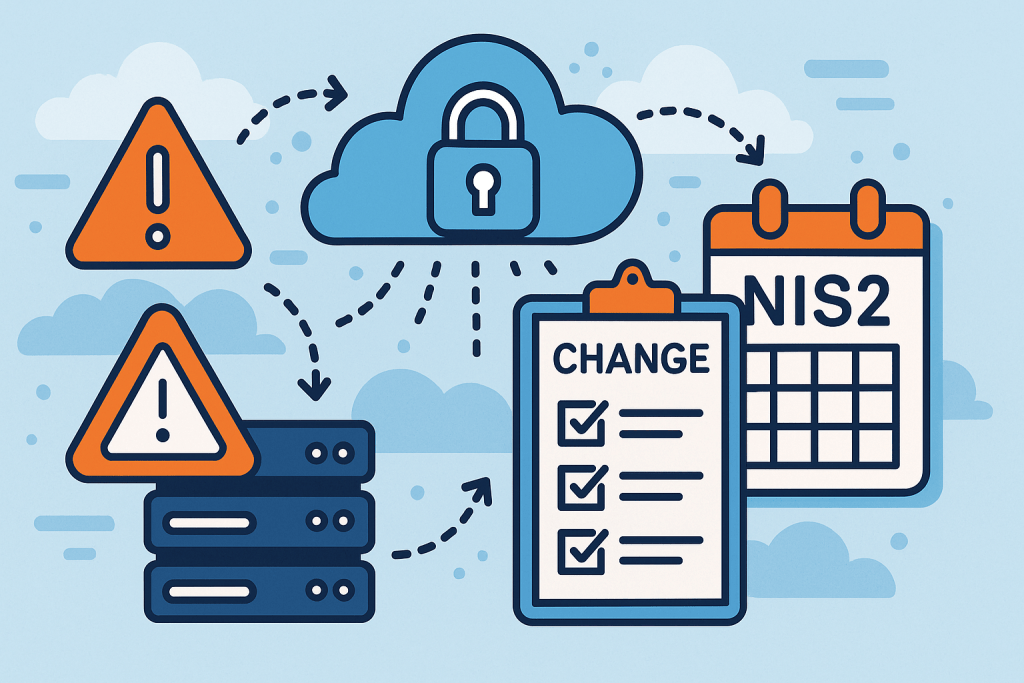
In many organizations, the change process is seen as a practical workflow and a way to manage updates, releases, and changes to systems and services. But in an NIS2 context, it is something else entirely, one of the most critical security controls in the business.
Most major incidents don’t occur due to mysterious hackers, but rather due to changes. Incorrect updates, lack of communication, or inadequate risk assessments are often the direct cause of downtime, vulnerabilities, and security breaches.
NIS2 requires that organizations must be able to prevent, detect and manage risks associated with changes – and this makes the change process one of the most central areas.
Change is one of the biggest sources of risk
Any change, small or large, can create unintended consequences. It could be opening a port, deploying a new version of a service, changing providers, or making configuration adjustments.
A weak change process means that these risks creep into the business without anyone catching them along the way. In NIS2 terms, this means lack of risk management, insufficient technical and organizational measures, and lack of control over critical systems.
A poor change process is not only ineffective – it is a direct security risk.
Control, traceability and predictability – the core of NIS2
NIS2 is built on robustness and resilience. To meet the requirements, a change process is needed that provides:
- Traceability: What was changed, when, by whom and why?
- Predictability: Risk assessments and approval flows that ensure quality.
- Documentation: All relevant information should be collected prior to audits.
- Connection to systems, services and dependencies: To understand consequences and risks.
Without a structured change process, it becomes virtually impossible to demonstrate compliance.
The hub between operations, security, development and management
A change is never just technical. It affects the business, the users, the security and often even the supply chain.
A modern change process functions as a hub where several competencies meet:
- Operation ensures stability
- Development takes responsibility for quality
- Security assesses risks and measures
- Management ensures that decisions follow plans and life cycle strategies
This is one of NIS2's clearest points: organizations must work more cross-functionally.
Speed and control don't have to be opposites
Many people believe that a robust change process automatically means slower deliveries. It's the opposite.
When processes are clear, traceable and partially automated, uncertainty and the number of acute incidents are reduced. This allows the pace of change to increase without the risks that come with it.
Fast and secure is entirely possible. NIS2 makes it necessary.
The link to risk management and continuity
The change process is one of the few places where risk management becomes concrete. Every change is an opportunity to:
- identify risks
- make impact assessments
- manage dependencies
- communicate impact
- prevent future incidents
In the NIS2 context, the change process ties together many of the mandatory areas from incident management and security measures to supplier control and continuity plans.
This is what an NIS2-ready change process looks like
A change process that meets the requirements and at the same time gives the business security and control is characterized by:
- Clear roles and decision points
- Documentation and traceability
- Built-in risk assessment
- Impact analysis based on CMDB and/or service catalog
- Fast track for low risk, robust control for high risk
- Ability to stop, pause, or rewind
- Communication to affected units
- Link to management plans and life cycle work
This is not just “good practice.” In many cases, it is exactly what NIS2 requires businesses to demonstrate.
Change is security, not administration
A good change process is no longer a support tool in IT. It is one of the most important protection mechanisms in the business.
It reduces the risk of incidents, strengthens compliance with NIS2 and creates the conditions for rapid development without compromising security.
Organizations that take the change process seriously are better equipped both during audits and when the unexpected occurs.
Read more
Here are some articles on easit.se that complement the topic.

Henrik Traveler
Commercial Product Manager
henrik.resare@easit.com
+46 70 249 36 06