
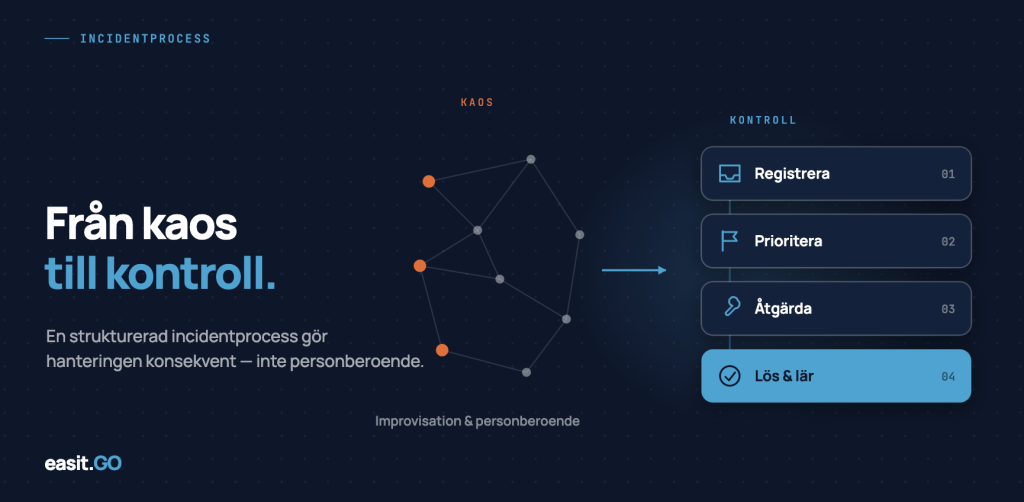
An incident always occurs at the wrong time. It is not a problem that can be solved, it is a basic condition to be dealt with.
What can be resolved, however, is what happens once the incident is a fact, whether there is a process that guides the work, or whether improvisation and personal dependence take over.
What chaos looks like in practice
Most organizations have experienced it.
A critical service stops working. Someone notices it and sends an email. Someone else gets in touch by phone. A third person hears the rumor and opens a case in the system. No one knows who owns the issue, if anyone is working on it, or how serious it really is.
It's not a sign that employees are sloppy. It's a sign that there's a lack of process.
An incident process defines what happens from the time an incident is identified to the time it is resolved and documented. It makes work predictable, reduces person dependency, and ensures that the right things happen in the right order, regardless of who happens to be on site when the incident occurs.
Prioritization that actually guides the work
Not all incidents are equally serious. But without a clear prioritization model, they are often treated as if they were, or, conversely, everything ends up in a pile where the loudest issue gets the attention.
A functioning prioritization model is based on two factors: impact and urgency.
Impact is about how many users or how critical systems are affected. An incident that stops a single employee is serious, but an incident that knocks out a system that the entire business depends on requires an immediate response.
Urgency is about how quickly the situation will worsen if nothing is done. An incident that is escalating by the minute requires different handling than one that is stable but disruptive.
The combination of these two factors provides a priority matrix that can be applied consistently by whoever receives the incident.
Escalation paths – who does what when
The priority determines how quickly an incident must be handled. The escalation path determines who handles it and when more people need to be involved.
A clear escalation structure contains three things: role descriptions, time limits, and communication channels.
The role descriptions define who is responsible for what at each priority level. Not named people, but roles so that the process continues even when key people are absent.
Time limits specify how long an incident at a given priority level can last before it is escalated to the next level. This is what ensures that incidents do not silently fall through the system.
The communication channels specify who is informed when, not only internally at IT, but also towards the parts of the business affected by the incident.
Communication during an ongoing incident
One of the most common shortcomings in incident management is not the technical handling, it is the communication with those affected.
Users and business owners need to know three things: that the problem is known, that it is being addressed, and when they can expect more information. That's all there is to it. But it's enough to reduce pressure on the help desk and provide reassurance.
A structured incident process includes communication templates and automated notifications that are triggered by status changes. This frees up time for the incident manager to focus on the solution, not on answering status questions.
Closing an incident correctly
An incident is not resolved when the service is back up and running. It is resolved when it is documented, evaluated, and the lessons learned are addressed.
The final step in an incident process, the post-incident review, or PIR, is what determines whether the organization learns from what happened. What was the root cause? What worked in the process? What didn't work? What needs to be addressed to reduce the risk of recurrence?
Organizations that consistently conduct PIR after major incidents build a systematic ability to handle disruptions. Those that skip it end up solving the same problems over and over again.
NIS2 has raised the bar – a new dimension for many
For organizations covered by the NIS2 Directive, incident management is no longer just an internal matter. Serious and reportable cybersecurity incidents must be reported to the MSB, the Police and the Swedish Data Protection Authority.
It requires a process that not only handles the incident operationally, but also ensures that documentation and reporting is done in the right format and within the right timeframes. Without structural support it is an unreasonable requirement, with the right process it is manageable.
Easit GO has a ready-made incident process for cybersecurity incidents, adapted for NIS2 reporting requirements with six clear steps from initial assessment to completed documentation.
Frequently asked questions
What is the difference between an incident and a regular case?
An incident is an unplanned event that disrupts or threatens to disrupt a service. It is handled in a separate flow with prioritization, escalation rules, and communication requirements separate from regular case management.
How do you set the right priority for an incident?
Base the priority on impact (how many and how critical systems are affected) and urgency (how quickly the situation is deteriorating). A simple matrix of these two factors provides consistent prioritization regardless of who receives the incident.
What is required to meet NIS2's incident management requirements?
A process that enables rapid identification, documentation and reporting to MSB, the Police and IMY in the event of serious cybersecurity incidents, with full traceability for every step in the handling.
An incident process is not a project with an end date. It is a capability that is built step by step – and that makes a difference every time something goes wrong.
Would you like to see what a structured incident process looks like in Easit GO? Book a demo
Read also: From incident to report – GO supports NIS2 requirements

Henrik Traveler
Commercial Product Manager
henrik.resare@easit.com
+46 70 249 36 06