
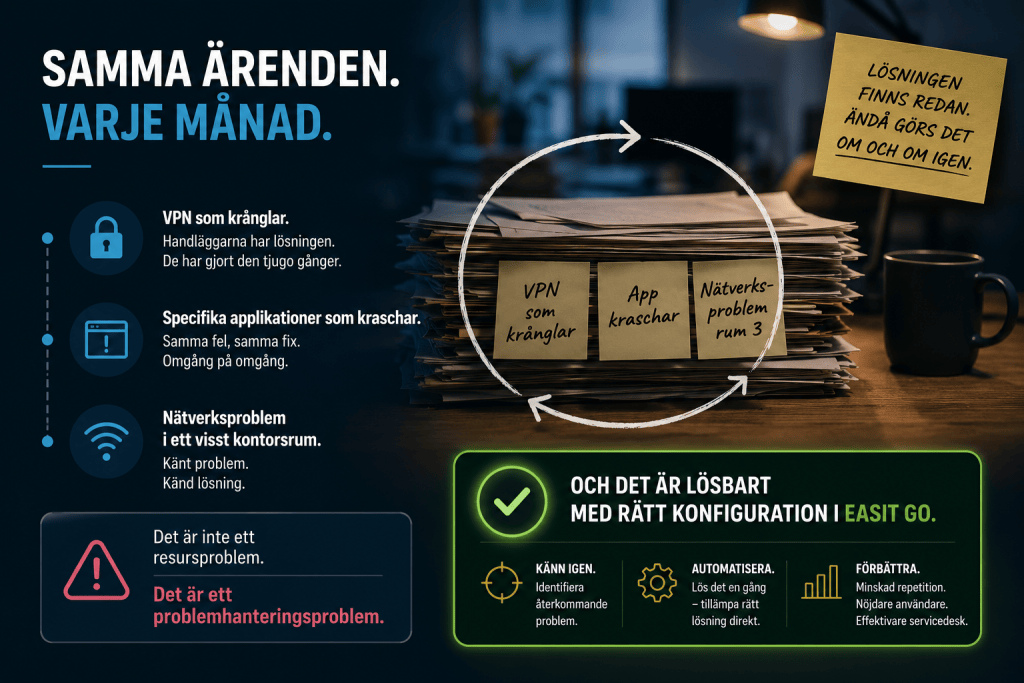
Every month, your service desk handles a number of cases that it has handled before. VPNs that are having problems. Specific applications that are crashing. Network problems in a specific office space.
The agents know the solution by heart – because they have done it twenty times. It is not a resource problem. It is a problem management problem. And it is solvable with the right configuration in Easit GO.
Incident vs. problem – a distinction that changes everything
In ITIL terminology, the difference is clear. An incident is an interruption, a problem is the underlying cause of the interruption.
In practice, most service desks only handle incidents. The user reports that the VPN is not working. The agent restarts the connection and closes the case. The next week, another user reports the same thing.
The incident is resolved. The problem still exists.
Problem management is the process of moving from “we fix it every time it happens” to “it won’t happen again.” It requires identifying patterns in incident data, isolating the root cause, and implementing a permanent solution.
It is one of the processes that has the most long-term effect in a service desk and one of the least implemented.
Why it is not being implemented and why it is the wrong priority
The most common argument against starting with problem management is that it seems time-consuming. You have to analyze root causes, conduct investigations, document everything.
That argument misses one fact. You're already paying for the problem.
Every time an agent resolves the same incident for the tenth time, time that could have been spent on something else is wasted. If twenty similar incidents per month take 30 minutes each, you are paying for ten hours of work each month for a problem you never fix.
A root cause analysis that takes four hours and eliminates twenty incidents per month pays for itself in three weeks.
The problem management process in Easit GO
In Easit GO, problem management is standard and a separate case type – Problem – with its own status flows, fields and assignment rules. This allows problems to be managed in parallel with the daily incident stream without them competing for priority.
Step 1: Identify problem candidates. Run a report on incidents by category and sort by frequency. Incident types that recur more than three times per month are problem candidates. In Easit GO you can filter by category, handler group and time period, the analysis takes minutes.
Step 2: Create a Problem Case and link incidents. When a problem candidate is identified, a problem case is created in Easit GO. Existing and future incidents of the same type are linked to the problem via relationship management. This means that case managers who receive a new incident immediately see: “this is a known problem, here is the workaround.”
Step 3: Root cause analysis. The problem case documents the analysis work: what is the underlying cause? What is required to eliminate it permanently? Who is responsible for the action? Timeline?
Step 4: Known Issue and Workaround. While the permanent solution is being developed, the case is documented as a known issue with an associated workaround. This information is available to all case managers and can be exposed in the self-service portal so that users can find the workaround without contacting the service desk at all.
Step 5: Close the issue when the root cause is eliminated. Once the permanent solution is implemented, the issue is closed. Incidents of this type should now cease. If they continue, there is a new issue to investigate.
What it brings in the long run
The effect of a functioning problem management process is cumulative. Every problem that is eliminated permanently reduces the case volume. The agents are freed from repetitive work. The knowledge base grows with every Known Error that is documented.
Organizations that work systematically with problem management typically see 15–25% lower incident volume per year. Not as a one-time effort, but as a continuous trend.
It frees up capacity for proactive work, system improvements, automation, implementation of new technology. It's the difference between an IT department that runs after problems and one that prevents them.
Where do you start?
Don't start by trying to cover everything. Select the five most common incident categories from Easit GO and choose one of them to perform root cause analysis on.
Run the analysis, document the findings, implement the solution, and measure the outcome. If the incident rate drops in that category, you have proof that the process is working in your environment. Then add additional categories gradually.
It's an iterative start, not a large-scale implementation.
Frequently asked questions
What is the difference between incident and problem in ITIL? An incident is an interruption. A problem is the underlying cause of one or more incidents. Incident management restores service quickly. Problem management eliminates the root cause.
How do you configure problem management in Easit GO? Problems exist by default as a separate case type with their own status flows. Incidents are linked to problems via relationship management. Known errors are documented with workarounds and exposed in the knowledge base.
What is a known error database? A collection of documented problems where the root cause is identified but a permanent solution is missing. Contains workarounds that administrators can use immediately, and which can be exposed in the self-service portal.
Do you need ITIL certification to work with problem management? No. ITIL certification is optional. Problem management is a pragmatic approach that any IT department can apply regardless of formal certification level.
Every minute spent resolving the same incident again is a minute not spent preventing the next one. Problem Management in Easit GO gives IT the tool to systematically break that pattern.
Want to see what problem management looks like in Easit GO? Book a demo
Read also: ITIL in Easit GO: What it actually means – and what it doesn't have to mean

Henrik Traveler
Commercial Product Manager
henrik.resare@easit.com
+46 70 249 36 06