New research shows that employees are losing hours every week to sluggish IT systems and slow processes. But for organizations that manage business support in silos, the hidden cost of IT inefficiency is much greater than what IT departments measure, and the solution is Enterprise Service Management.
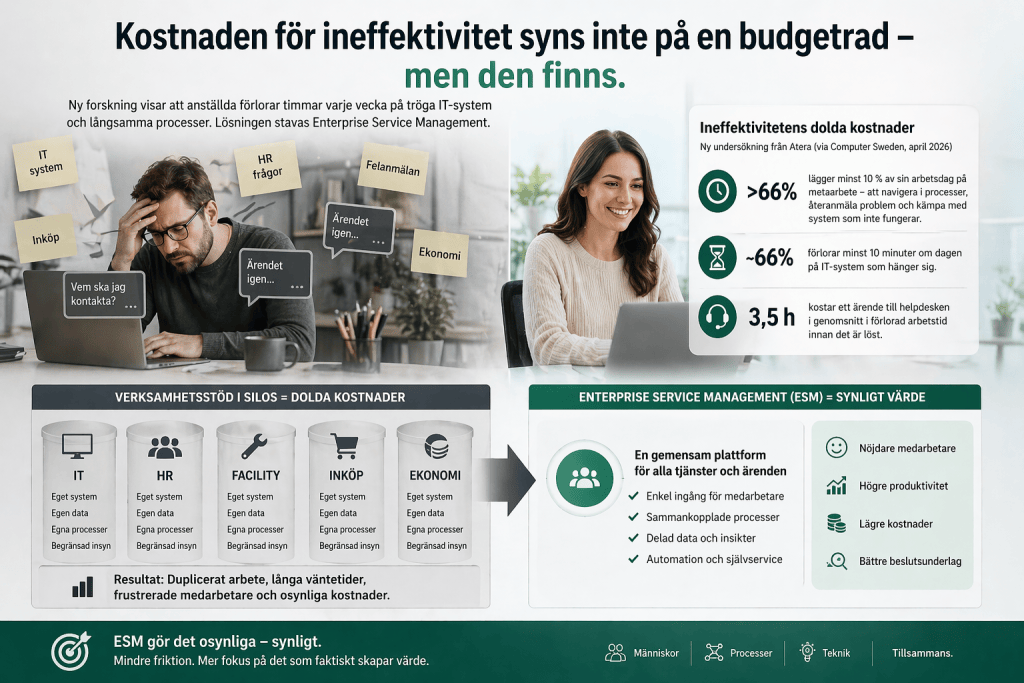
In April 2026, Computer Sweden published an article based on a survey by helpdesk provider Atera. The numbers were telling: more than two-thirds of employees spend at least ten percent of their workday on so-called metawork, navigating processes, reporting problems, and struggling with systems that don't work.
Almost two-thirds lose at least ten minutes a day to IT systems that hang. And a helpdesk case costs an average of three and a half hours of lost work time before it is resolved.
These are startling numbers. But what makes them particularly relevant is not what they show – but what they don't show.
What is the real cost of IT inefficiency?
One of the experts quoted in the Computer Sweden article, Collin Hogue-Spears from Black Duck Software, puts his finger on the crux of the matter: the cost of IT inefficiency is not visible on a single budget line. It is scattered, invisible and systematically undervalued. And that is precisely why it is rarely addressed.
It's easy to see the cost of a new system, a consulting project, or a license. It's harder to see the cost of the 45 minutes a controller spends waiting for an access issue to be resolved, the three reprioritizations it required, and then losing track of the budget that was supposed to be ready by lunchtime.
Hogue-Spears calls it a “ghost workforce,” resources that are paid for but cannot work productively. It’s an apt description. And we at Easit would add that this ghost workforce is not limited to the IT department.
IT inefficiency is an ESM problem, not just an ITSM problem
The natural reaction when reading about help desk inefficiency is to think of IT support cases. The computer won't boot. The password is locked. The system is unresponsive.
But in organizations that have worked with Enterprise Service Management (ESM), the principle of using the same structured, process-based approach for all business support functions, not just IT, the pattern looks different.
The inefficiency lies in the transitions.
Consider a common scenario. A new employee starts on Monday. HR has done its part. IT has received an order. But no one has told facility management that a key card is needed. No one has connected the IT order with the purchase of hardware that is actually in a warehouse three departments away. And the manager who is supposed to approve access to the business system is in a conference call.
The result? The new employee sits idle for half a day. Not because the help desk is bad, but because the processes are not connected.
That's the cost the Atera survey doesn't measure. And that's the cost that may actually be the greatest.
How do you measure the cost of IT inefficiency and business processes?
Frank Meltke, CEO of the consulting firm contraco, makes an important distinction in the Computer Sweden article, not all friction is unnecessary. Strong security protocols and compliance requirements by definition involve a certain amount of meta-work. The goal is not to eliminate all friction, it is to distinguish the necessary from the unnecessary.
It's a distinction we recognize well from conversations with our customers.
Organizations that have implemented Easit GO to digitize and structure their service processes – whether it’s IT, HR, facility, legal or purchasing – consistently report that it’s not the technical friction that costs the most. It’s the administrative one. Manual handling of cases. Approval flows via email. Information that exists in three different systems but is not complete in any of them. Prioritizing gut feelings rather than data.
That friction is unnecessary. And it is measurable, but only if you decide to measure it.
Visibility in service processes is the prerequisite for change
Hogue-Spears recommends that IT managers use tools to measure the digital experience and compile quarterly reports. He's right. But we would expand on that advice.
It's not just about measuring the IT experience. It's about measuring the operational experience for the entire business support.
How long is the average resolution time for an onboarding case from start to when the employee is fully productive? How many cases are handled in sub-processes without the reason being documented? What percentage of SLA violations are due to the case being stuck waiting for a decision from another department?
Without an ESM system that collects that information – structured, with a common data model and common processes – the answer to those questions is “we don’t know.” And it’s that very answer that means the management team never sees the ghost workforce in their report.
AI in IT support, the amplifier, not the solution
The Atera study naturally highlights AI as part of the answer. AI-powered helpdesks can reduce response times, automate Category 1 cases, and free up resources for more complex problems. That’s right. Those are real gains.
But AI amplifies what already exists. If the basic data is good, the process discipline is high, and the cases are well-structured, then AI becomes a powerful lever. If they are not, AI is a quick answer to the wrong question.
We see this in the organizations that have started using AI-powered case triage and classification in Easit GO. The ones that get the most value are those that have already laid the foundation with clear case types, well-defined processes, consistent categories. That's where AI can take over and really make a difference.
Those who jump straight to AI without the underlying structural work will end up with a more automated version of their current chaos.
Four steps to reduce the cost of IT inefficiency
The Computer Sweden article highlights some practical advice, especially for smaller organizations. We agree, and for medium-sized and larger organizations with complex business support needs, we would like to add:
- Start measuring what costs but is not visible. Identify the processes that are currently handled via email, phone or informal channels. That is where the hidden cost of IT inefficiency lies.
- Connect departmental processes. Onboarding, purchasing, IT support and facilities are not separate islands. They share cases, data and dependencies. Manage them in a common ESM system.
- Make data available for decision-making. Reports on case volume, resolution time, and SLA fulfillment shouldn't require an analyst. They should be readily available to the managers responsible for business support.
- Build for AI, not with AI. Invest in the structure – data taxonomy, case categories, process definitions – so that AI can add real value to service processes when it is added.
Frequently Asked Questions about IT Inefficiency and Enterprise Service Management
What is the cost of IT inefficiency in an organization?
According to research from Atera (2026), employees lose an average of three and a half hours of work time per helpdesk case, and more than two-thirds of employees spend at least ten percent of their workday on IT-related meta-work. For organizations without interconnected service processes, hidden costs arise in the form of delayed onboarding, manual case management, and decisions made without data.
What is the difference between ITSM and ESM?
ITSM (IT Service Management) refers to structured processes for managing IT services and IT support. ESM (Enterprise Service Management) extends the same principles and tools to the entire organization – HR, facilities, purchasing, legal and other business support functions. The goal of ESM is to create a common data model, common processes and a unified system for all service requests, regardless of which department is responsible.
Is there support in Easit GO for Enterprise Service Management?
Easit GO is an ESM platform that allows organizations to digitize and automate service processes for IT, HR, facility and other departments in one system. With Easit GO, business support gets a common case model, rules-based workflows, real-time reporting and support for AI-driven classification and triage – directly addressing the costs that are otherwise invisible.
Conclusion: Make the cost of IT inefficiency visible
The Atera survey that Computer Sweden refers to puts important numbers on a problem that many organizations suspect but rarely measure. The fact that employees lose dozens of minutes a day and IT managers hours a week on inefficient IT management is costly in itself.
But the deeper point is that the cost of IT inefficiency never shows up in the right place in the organization. It is scattered, invisible, and therefore systematically undervalued.
That's the problem Enterprise Service Management addresses. Not by eliminating all friction, but by making it visible, structured, and measurable – so that the organization can finally make informed decisions about where to allocate resources.
The ghosts disappear when you turn on the lamp.
Easit AB is a Swedish software company with over 25 years of experience in service management. Easit GO is an Enterprise Service Management platform used by the public sector, municipalities and medium to large private organizations in the Nordic region.
Source: The cost of inefficient IT can be enormous – Computer Sweden, April 2026

Henrik Traveler
Commercial Product Manager
henrik.resare@easit.com
+46 70 249 36 06