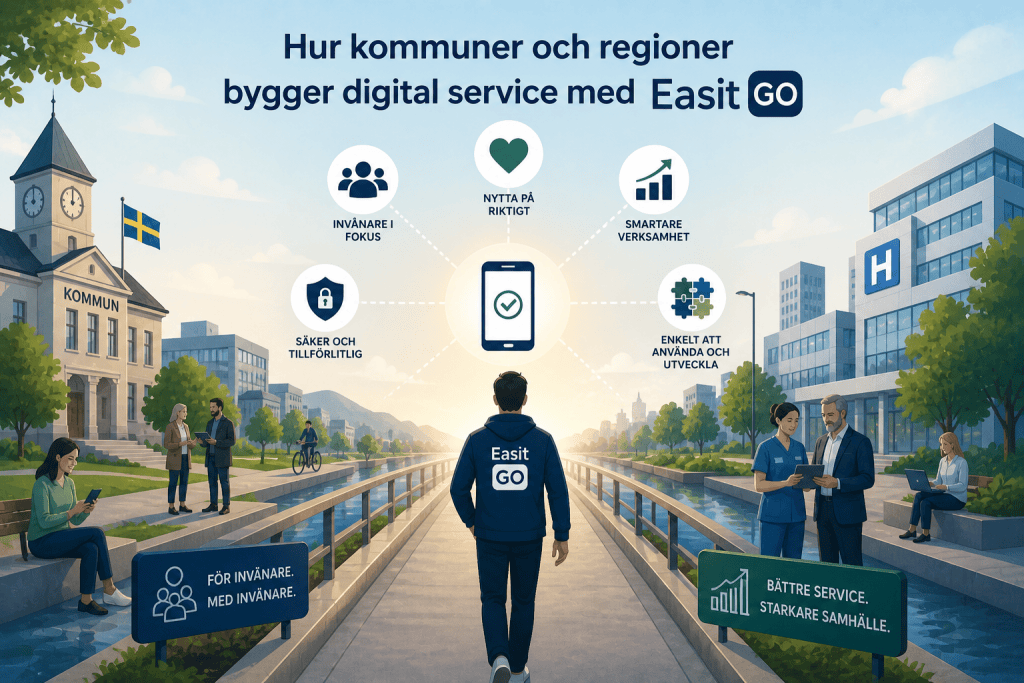
The public sector has high demands on IT systems: GDPR must be met, procurement is carried out according to LOU, data must not leave Sweden, and budgets are often tight.
These are not easy conditions for digital modernization. Yet it is in municipalities and regions that some of the most well-thought-out implementations of Easit GO are found, and they show the way for anyone who wants to build sustainable digital services.
The public sector's challenges are not unique – they are amplified
Every organization that is going to implement a case management system faces similar questions: what processes should be supported, how does it integrate with existing systems, what does training and onboarding look like?
In municipalities and regions, these issues are reinforced by some additional dimensions.
GDPR and data protection. Citizen-oriented activities involve handling personal data about individuals – social service cases, healthcare-related issues, permit applications. The requirements for where data is stored and who has access are many times stricter than in the private sector.
LOU and procurement process. Systems are not purchased ad hoc. The procurement process takes time and requires clear documentation of requirements and the supplier's ability to meet them.
Heterogeneous system landscapes. Municipalities often operate a large number of business systems from different suppliers, procured during different periods. The case management system must function in that landscape and not require everything to be replaced.
Limited IT resources. Many municipalities' IT departments manage a broad infrastructure with a relatively small team. The systems must be able to be configured and managed without dedicated specialists.
It is a demanding landscape of requirements. That is also why the municipalities and regions that have come a long way with their digital services have been forced to think through their choices carefully and why their experiences are valuable for all types of organizations.
How a Swedish municipality modernized its service desk
One of the municipalities working with Easit GO faced a well-known problem: case management worked, but not well enough. Cases were partly handled via email and phone. Status updates were sent out manually. It was difficult to see patterns in what was driving the case volumes.
The decision to modernize was not primarily about purchasing a new system, it was about creating a structured process around case management and then building on it.
What sets the implementation apart from a standard installation is that they chose to integrate AI functionality directly into the service desk. With Easit GO's AI-agnostic architecture, an AI service was connected that meets GDPR requirements.
The result is a service desk where the AI agent handles simple and recurring questions, the knowledge base deflects standard questions via self-service, and the agents can focus on the cases that actually require human assessment.
Three lessons that apply to all public sectors
- Start with the process, not the technology. The most common mistake when changing systems is to jump straight to the configuration. The municipalities that succeed take the time to map their case flows before touching a single setting option. What types of cases are there? Which ones require escalation? Where do the bottlenecks occur? That mapping is what makes the configuration in Easit GO actually reflect the business. Not a generic template that looks good on paper but doesn't match how the work actually goes.
- Data sovereignty is a requirement, not a selling point. Choosing an AI service should be made with data protection as the primary criterion, not functionality as the starting point. The fact that Easit GO is AI-agnostic means that the organization can choose a service that meets their specific requirements without being locked into a specific model. It is a decision that holds true when legislation changes and when new technology emerges. Choosing the wrong path from the start is costly to reverse.
- Self-service and AI are not a replacement for competent agents. It is a selection process. AI and knowledge databases handle what is standardized and repeatable. It frees up agents' time for what requires context, experience and human judgment. It is a better job for agents and a better service for citizens.
What the private sector can learn
The public sector's requirements are high, but they are not unique. In practice, they are the requirements that all organizations should place on their IT systems.
Where is your data stored, and who has access to it? It's not just a GDPR issue, it's a business continuity issue.
Can you change the AI model without changing the system? It is not only relevant for municipalities with LOU requirements, it is relevant for anyone who does not want to build in a dependency on a specific technology.
Can the system grow with the organization's needs, without requiring a new procurement each time? Municipalities are forced to think about it. The private sector should do it voluntarily.
Frequently asked questions
Can municipalities use Easit GO with GDPR-sensitive data?
Yes. Easit GO can be operated in a Swedish environment, which means that personal data stays in Sweden and is handled under Swedish and European legislation.
Can Easit GO be procured according to LOU?
Easit GO can be procured via public procurement in accordance with the Swedish Public Procurement Act. Contact Easit for information about framework agreements and procurement documents adapted for the public sector.
Is Easit GO suitable for both IT and citizen services?
Yes. Easit GO is an ESM platform that supports multiple departments in the same instance. Municipalities can use it for internal IT support, HR processes and citizen-centric case management with separate portals, in the same platform, per area of operation.
Digital services in the public sector do not have to be a landscape of compromises. With the right system, the right process and the right mindset around data protection, municipalities and regions can build services that are modern, secure and sustainable.
Would you like to discuss how Easit GO can work in your municipality's or region's specific environment? Contact us or book a demo
Read also
Easit GO and data sovereignty – digitize with personal data without the data leaving Sweden
Easit GO – Your process engine for digitalization and automation

Henrik Traveler
Commercial Product Manager
henrik.resare@easit.com
+46 70 249 36 06