A case management system is one of the IT department's most critical tools, yet it's often chosen based on the wrong parameters – price, user interface, or a demo's sales pitch.
This guide gives you seven concrete requirements to make of your next system, and shows how Easit GO relates to each requirement.
What is a case management system and what should it actually do?
A case management system is the software that enables IT departments (and entire organizations) to receive, track, prioritize, and resolve cases in a structured manner.
But a good case management system does much more than organize your email inbox. It creates a learning organization – a system that, with every case closed, builds knowledge, improves processes, and identifies recurring problems before they escalate.
That's the difference between a reactive service desk and a preventive service desk.
Why system choice is more important in 2026 than it was in 2020
In recent years, the requirements for case management systems have changed dramatically:
Self-service is a hygiene factor. 79% of users expect to be able to resolve their issues via a self-service portal. If your system doesn't offer this, it creates unnecessary strain on agents.
AI is not a bonus – it’s a requirement. Automatic categorization, case routing, and AI-assisted responses are now standard expectations in modern organizations.
The entire organization should be able to use it. An IT department's case management system that cannot be extended to HR, finance or real estate is a silo approach that costs money unnecessarily.
Operational flexibility is a security issue. With increased data protection requirements and a more complex threat landscape, many organizations, especially the public sector, need to be able to choose where data is stored and how the system is operated.
7 requirements you should have for your case management system
Requirement 1: Configurability should not require consultants
The system should be customizable by your own administrators without programming skills. If every process change requires a consulting invoice, you haven't bought a tool, you've bought a dependency.
Easit GO is built on no-code configuration. Processes, forms, automation rules and interfaces are customized via a visual interface without a single line of code.
Requirement 2: On-premises and SaaS should be a choice, not a compulsion
Cloud solutions suit many, but not everyone. Public sector businesses, banks, and security-critical organizations sometimes need data on-premises or in a private cloud environment.
With Easit GO you choose your operating model without changing the functionality. Do you want to move from on-premises to SaaS in three years? It's possible. Without a system change.
Requirement 3: ITIL support without ITIL fanaticism
ITIL is a framework, not a religion. Your system should support ITIL processes (incident, problem, change, release, etc.) without forcing you to implement all or nothing.
Easit GO is ITIL compliant but not ITIL locked. You implement the processes your organization actually needs.
Requirement 4: ESM capability – not just IT
A modern case management system should be able to handle cases for the entire organization, without compromise. HR cases, facility requests, supplier approvals, all in one system with common reporting.
Easit GO is built from the ground up as an ESM platform, not an IT tool that patches HR functions together afterwards.
Requirement 5: Automation and optional AI integration
Manual categorization and case assignment is 2015. Your system should be able to automate repetitive decisions based on rules and patterns and give you the freedom to connect AI support where it adds value.
Easit GO offers powerful rule-based automation for repetitive decisions and flows. For AI, you choose which service to connect, Easit GO is model-agnostic and does not lock you into a single provider. You connect the AI service that meets your specific requirements for GDPR, information security and procurement. Same platform, your AI choice.
Requirement 6: GDPR and Swedish supplier
If you handle personal data – and everyone does – your provider should have clear answers about where the data is stored, how long, who has access and what happens in the event of a data breach.
Easit is a Swedish company with a European reach. Data is handled in Sweden. Agreements and responsibilities are clear, transparent and can be procured under LOU. No ambiguity about legal residence or data transfer outside the EU.
Requirement 7: Reporting and BI integration that is actually usable
“We have reports” is not enough. The reports should be available to the right people, in the right format and able to be linked to the organization’s own KPI definitions.
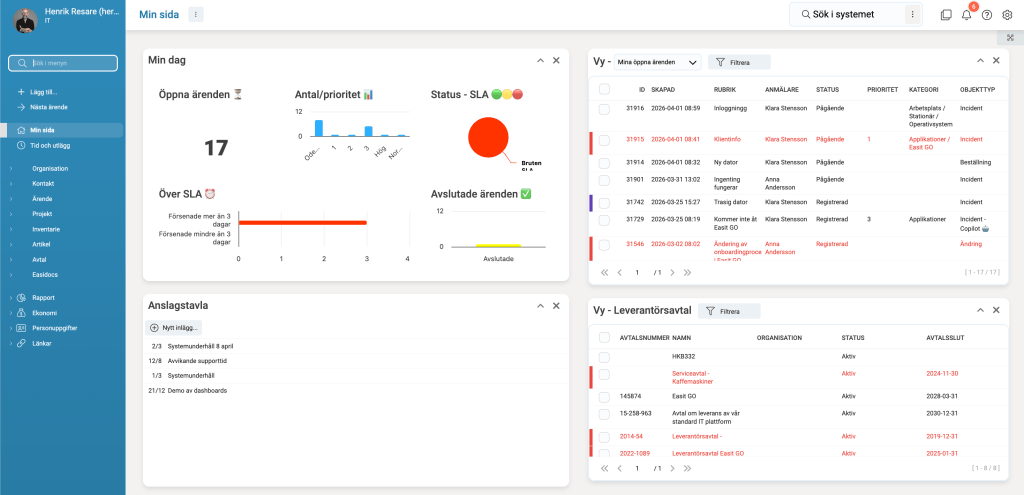
Easit GO includes ready-made dashboards and reports that IT managers and business managers can read directly – and that can be customized to your own metrics. Want to continue working in Excel? Simply export and continue the analysis there.
Do you prefer a dedicated BI tool? Easit GO integrates with any BI system for deeper analysis and custom visualizations. You choose how you want to consume your data.
Frequently asked questions about case management systems
How much does a case management system cost?
The cost varies greatly depending on the number of users, scope of functionality and operating model. SaaS or on-premises solutions often start from a few hundred kronor per agent per month. Contact us for a price quote.
How long does it take to implement Easit GO?
A basic implementation typically takes 4–12 weeks depending on the size of the organization and customization needs. Thanks to no-code configuration, many settings can be done by your own staff without consulting assistance.
Can Easit GO be used in the public sector?
Yes. Easit GO meets the public sector's requirements for GDPR compliance, procureability, accessibility and data security. Data is stored in Sweden and the system can be operated on-premises if necessary.
What is the difference between case management systems and CRM?
A CRM manages customer relationships and sales processes. A case management system manages internal and external service cases and IT processes. The tools complement each other but are designed for different purposes.
The next step, how do you choose the right system for your organization?
The best case management system is the one that is actually used, by actual caseworkers, in actual processes. Not the one with the most features in a product matrix.
We recommend that you start with three concrete questions:
- Which processes are most painful to handle manually today?
- What requirements does your organization's data policy place on the supplier?
- What do you want to be able to do in three years that you can't do today?
The answers to these questions determine which system is right for your organization.
Would you like to see how Easit GO can concretely solve your organization's case management - and ask your own questions directly? Book a free and no-obligation demo with our team. Book demo
Read also:
AI in ITSM – choose the model that suits you
When support becomes a strategic player

Henrik Traveler
Commercial Product Manager
henrik.resare@easit.com
+46 70 249 36 06