Many organizations start their AI journey backwards: they choose a tool first and then try to fit their work into it. That’s a risky strategy when technology changes faster than organizations can adapt. The correct order is the reverse – your processes and your data are the assets, and AI is an interchangeable layer on top.
Models change faster than you can adapt
GPT-4 was launched in 2023 and was hailed as a breakthrough. Months later, models came out that performed better on specific tasks. Then came the next generation. Then the one after that.
It's not a sign that the industry is chaotic. It's the industry's normal state and it will continue.
An organization that chose a specific AI tool in 2024 and built its workflows around it has a problem today: not necessarily that the tool is bad, but that it is no longer the best option for all the tasks it is used for. And the lock-in makes it difficult to switch.
That's what vendor lock-in means. It's not that the supplier is locking the door, but that the organization's own processes, data, and integrations have made the switch too costly to implement.
Different tasks require different AI capabilities
Another reason to be skeptical of “one tool for everything” is that AI models actually differ depending on the task.
A model that is exceptional at summarizing long text is not necessarily the best at classifying cases. A model trained on technical documentation does not automatically perform as well on customer communication. An on-premise model that runs on-premises and meets GDPR requirements for sensitive personal data is not the same as a cloud-based model that provides broad capacity but cannot handle confidential information.
Choosing “one AI tool” is like choosing a single software tool for your entire IT environment. It doesn’t work in practice, and it shouldn’t work in theory either.
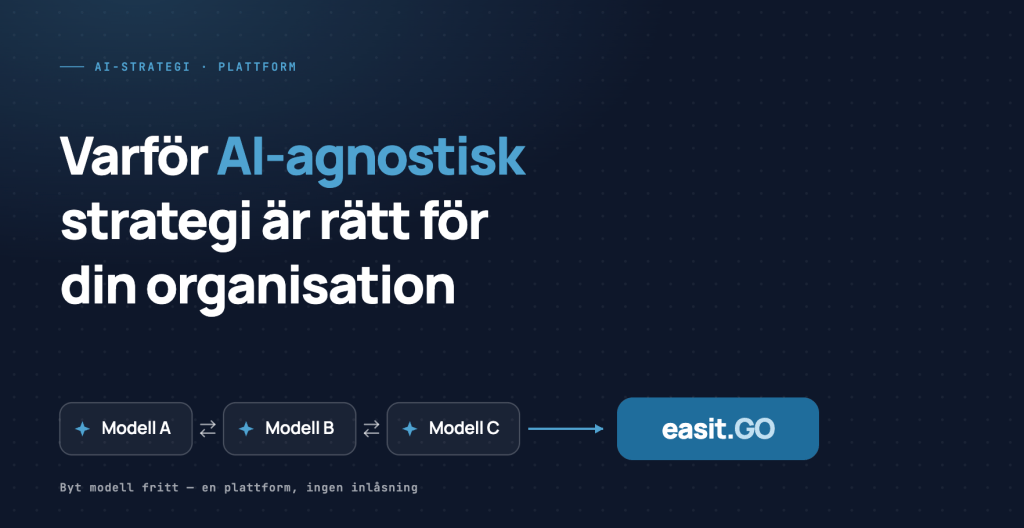
An AI-agnostic approach doesn't mean you use every available tool at once. It means your platform and processes are not locked to a specific tool and you can use the right tool for the right task, without having to rebuild your infrastructure every time you switch.
Your processes and your data are the asset
There is a fundamental misconception in how organizations often view AI: that the value lies in the model.
It does partly, but the value lies primarily in your processes and your data.
A well-structured case management process with clear categories, well-defined flows, and consistent documentation is worth more than whatever AI tool you connect to it. It’s your process that determines whether the AI classifies correctly, escalates at the right time, and provides useful answers – not just the inherent capabilities of the model.
This means that the organization that invests in structuring its processes and data is the organization that also maximizes what AI can do for it, regardless of which AI tool is best next year or month.
It also means that an organization that builds its processes around a specific AI tool, rather than around its own needs, loses control. Processes and data are adapted to the tool, not the other way around. And when the tool changes or is replaced, the organization is vulnerable.
What AI-agnostic looks like in practice
In Easit GO, processes, case flows, automations and documentation are managed in the platform. AI is a capability layer that is plugged in where it adds value – classification, summary, suggestions for next steps, preparation of documentation – without being the supporting structure.
This means you can connect the AI tool you already have, the one that best fits your data protection strategy, or the one that performs best for your specific task. As the AI market matures, you can switch or complement without having to start over with your processes.
The automation rules live in Easit GO. The documentation lives in Easit GO. The case history lives in Easit GO. The AI tool can be changed, but your data and processes remain.
Three questions to ask about your AI strategy
Before you make a decision about how to integrate AI into your workflows, there are three questions worth answering:
What happens if we want to change AI provider in a year?
If the answer is “it would require a major project,” you are already locked in or on your way there.
Do we own our data, or does the provider own it?
Training data, conversation history, and process data are strategic assets. The terms of what the AI vendor is allowed to do with your data vary greatly.
Is AI a layer in our process, or is our process a layer in the AI interface?
The difference is crucial. The first is a tool you control. The second is an addiction you don't.
Lorem ipsum dolor sit amet, consectetur adipiscing elite. Ut elit tellus, luctus nec ullamcorper mattis, pulvinar dapibus leo.
Frequently asked questions
What does AI-agnostic strategy mean?
Your processes, data, and workflows are designed to work with any AI tool – not dependent on a specific vendor. The platform and processes are constant; the AI tool is interchangeable.
Why is vendor lock-in a problem with AI?
AI models and vendors are changing rapidly. Pricing models change, capabilities shift, new players emerge. An organization that has built its processes around a specific AI tool risks having to restart every time the market changes.
How do you connect AI to existing workflows?
Have a platform that manages the processes and let AI tools act as a capability layer on top. AI can be called in where it adds value, without the entire workflow being dependent on a specific vendor.
Your AI strategy shouldn't start with a tool. It should start with your processes and a platform that enables you to connect the right AI for the right task, now and in three years.
Want to see how AI integration works in Easit GO? Book a demo
Read more!

Henrik Traveler
Commercial Product Manager
henrik.resare@easit.com
+46 70 249 36 06